Honestly, most people don't think about noise until it starts affecting their sleep.
You close the window. You try a fan. Maybe you look up some solutions online and suddenly everyone's recommending trees, fences, or noise barriers like the ones you see along highways. But which one is actually worth your time and money?
I've seen this question come up a lot — especially from people living near busy roads or industrial areas. So let's just go through it properly, without the fluff.
Why Noise Is a Bigger Deal Than We Admit
Traffic noise on a typical road sits between 70 and 85 decibels. That's a lot. And it doesn't just annoy you — over time, constant exposure to that level of sound messes with your sleep, raises your stress levels, and affects your ability to concentrate during the day.
Most people just get used to it. But getting used to something doesn't mean it isn't causing harm.
When the frustration finally hits a limit, people start exploring options. And that's usually when the comparison between noise barriers vs trees & fences comes up.
What Is a Noise Barriers?
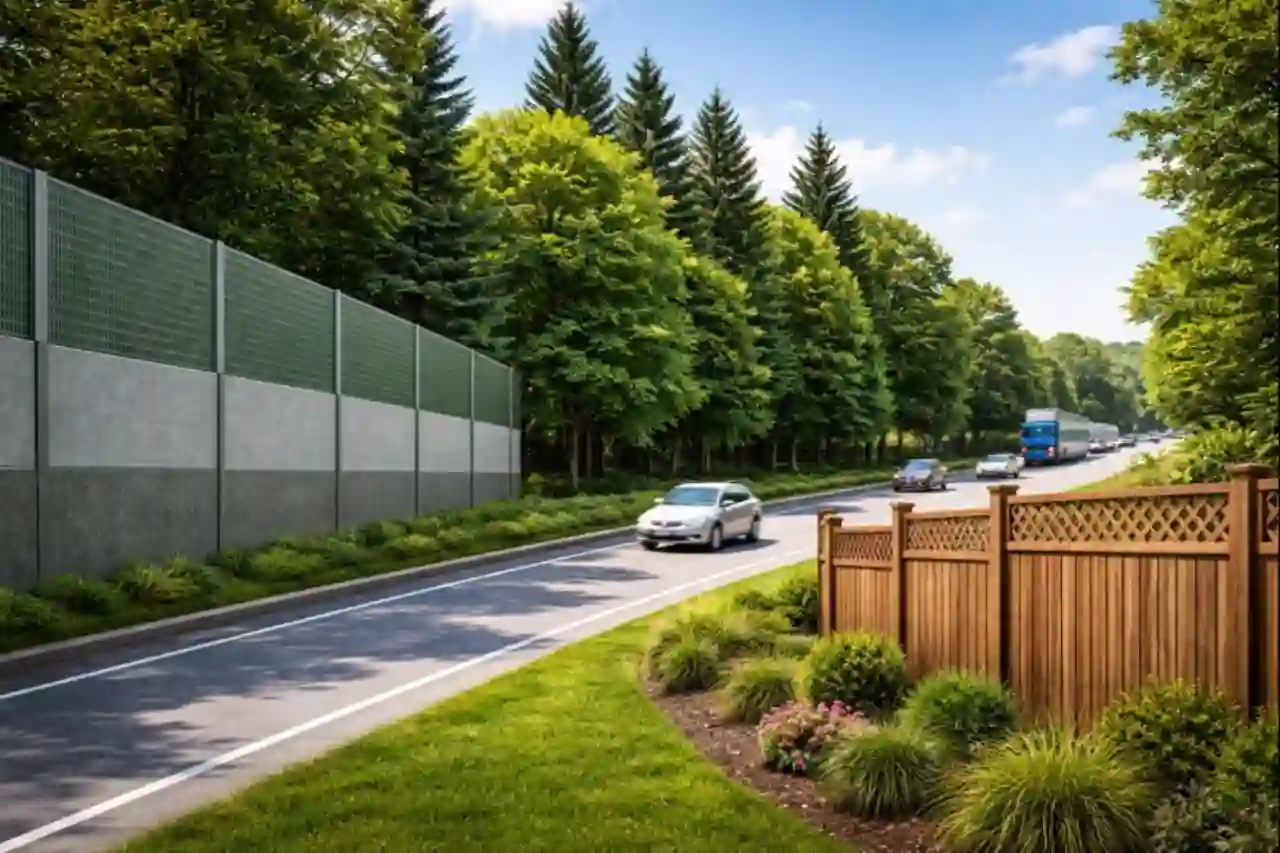
A noise barriers is basically a wall built specifically to stop sound from travelling from one place to another. It sounds simple, but the engineering behind it is more involved than people expect.
These walls are made from materials like concrete, metal panels, recycled rubber, or sometimes clear acrylic — depending on where they're being used and what the noise source looks like. The key thing is density and height. Sound travels in waves, and a barrier physically interrupts those waves before they reach the other side.
A good noise barriers, properly installed, can cut sound levels by 10 to 15 decibels. To put that in perspective — your brain perceives that as roughly half as loud. For someone living next to a highway, that's genuinely life-changing.
Do Trees Actually Block Noise?
This one surprises people. Trees look like they should work. They're thick, tall, green — it feels intuitive that a wall of trees would muffle sound.
But the numbers tell a different story.
A tree belt — even a really dense one — only reduces noise by about 3 to 5 decibels under good conditions. And to even get that much, you need the plantation to be at least 30 to 50 metres deep. That's not a garden hedge. That's basically a small forest.
On top of that, a lot of trees lose their leaves in winter or during dry seasons. When the leaves go, so does most of that small reduction. So the months when you're more likely to have your windows closed and notice indoor noise levels... are the same months your tree belt is doing the least.
Trees are great for a hundred other reasons. Air quality, shade, aesthetics. But they're not a real noise solution. Calling them one is just optimistic.
What About a Regular Fence?
A solid fence — no gaps, good height, dense material — can knock off maybe 5 to 8 decibels of sound. That's actually not nothing.
If your problem is a neighbour's generator running occasionally, or some ambient street noise barriers in a quiet area, a decent fence might take the edge off enough to matter. It's cheap, quick to install, and easy to understand.
But the moment you're dealing with something serious — a main road, a rail line, a factory — a fence just isn't built for that job. Sound goes around the edges. It diffracts over the top. It leaks through any gap at the base. The physics work against you.
Fences are fine as a small extra layer. As a primary noise solution, they fall short pretty fast.
Noise Barriers vs Trees & Fences: The Key Differences
| What We're Comparing | Noise Barrier | Trees / Green Belt | Standard Fence |
| Sound reduction | 10–15 dB (can go higher) | 3–5 dB | 5–8 dB |
| Time to work | Immediately after install | 10–20 years to mature | Immediately after install |
| Land needed | Minimal — just its own width | 30–50 metres deep | Minimal |
| Lifespan | 25–40 years | Variable, weather dependent | 5–15 years (wood) |
| Maintenance | Very low | Watering, pruning, replanting | Painting, repairs, replacement |
| Works year-round? | Yes | No (leaf loss reduces it) | Yes |
| Best for serious noise? | Yes | No | No |
| Cost over 20 years | Higher upfront, lower ongoing | Moderate upfront, ongoing care | Lower upfront, higher replacement |
The gap between noise barriers and the other two options is big when you lay it out like this. Especially on the things that matter most — actual sound reduction and long-term reliability.
That said, there's a reason experienced acoustic planners don't always say "just use a barrier and nothing else."
Using All Three Together
The smartest approach — and the one that tends to work best in practice — is to combine all three in layers.
The noise barriers does the real acoustic work. It's the main event. Trees on the outer side of the barrier reduce visual impact, lower temperature around the wall, and add some environmental value to the project. A fence on the residential side handles low-level ground noise and marks a clear boundary.
Each one plays a different role. None of them replaces the others. When people try to use just trees or just a fence because it seems cheaper or greener, they usually end up disappointed — and then they install a proper barrier anyway, having already spent money on the first attempt.
Not Every Barrier Is the Same
One thing worth knowing — the quality of your barrier matters enormously. Two noise barriers at the same height can perform very differently depending on material density, surface treatment, how the base is sealed, and how well the length covers the noise source angle.
This is why it pays to work with people who actually know what they're doing. SomNandi Industries has been building acoustic noise barriers for highway corridors, industrial zones, and residential buffers with a real focus on field performance — not just spec-sheet numbers. The difference between a barrier that looks right and one that actually works comes down to that kind of experience.
So, What's the Final Answer?
When it comes to noise barriers vs trees & fences, the honest answer is this:
If the noise is minor, a fence is fine. If you have space and patience, add some trees for environmental benefit. But if you're dealing with real, persistent, high-volume noise — the kind that keeps you up at night or bleeds into your workday — neither trees nor fences are going to solve it.
Only an engineered barrier does that job properly.
SomNandi Industries builds them to do exactly that. And once you've experienced what a proper noise barrier actually does to a space, it's hard to believe you were counting on a row of trees to get there.