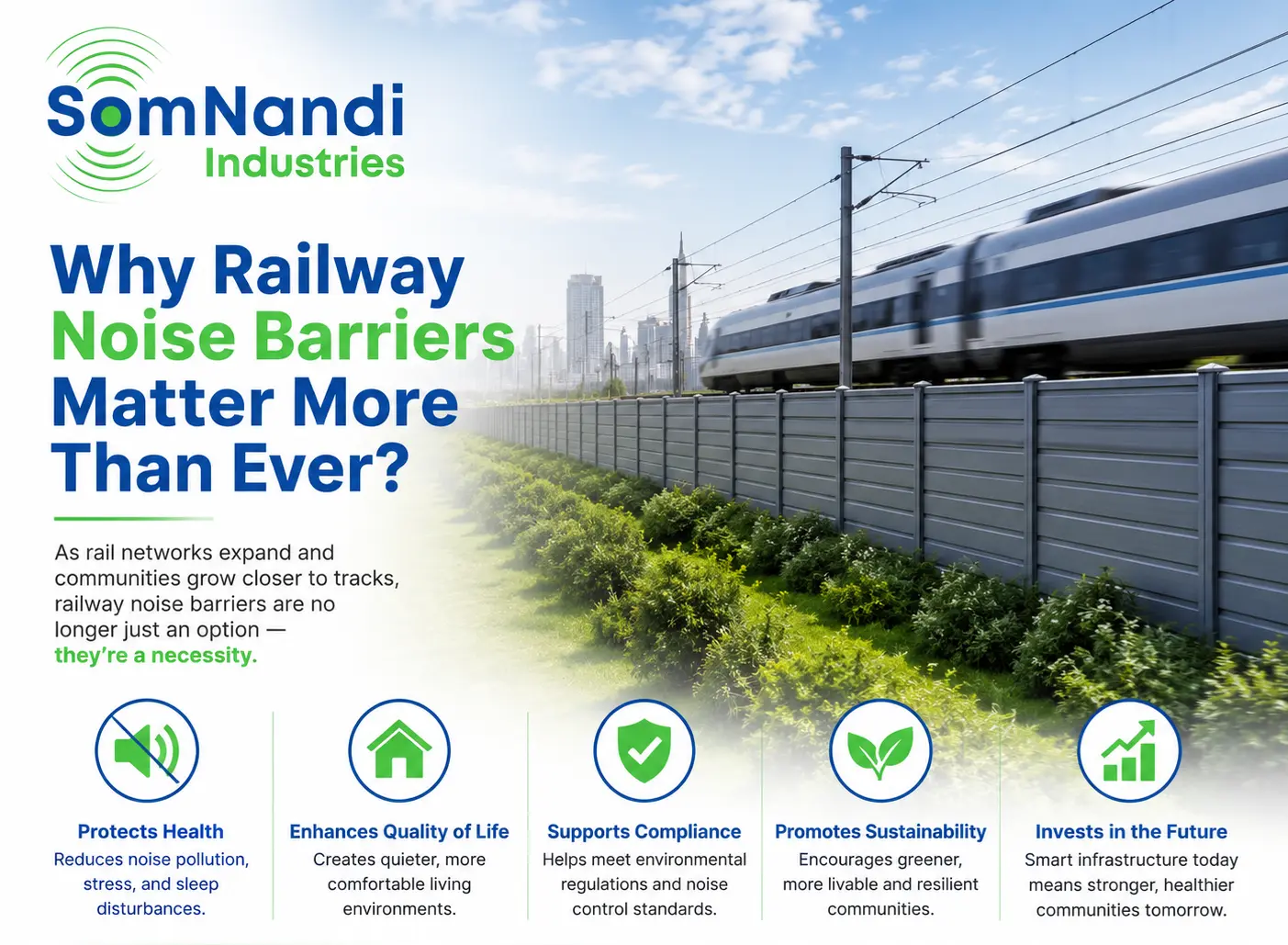
My neighbour hasn’t slept properly in four years. She moved into her house before the freight schedule changed, back when maybe three or four trains passed per night. Now it’s closer to twenty. She’s tried earplugs, white noise machines, blackout curtains — the whole toolkit of someone who’s quietly given up on asking for something better. What she actually needs, and what thousands of people in her situation need, are proper railway noise barrier solutions. Not eventually. Now.
I’m not writing this to be dramatic. I’m writing it because this problem is everywhere, it’s growing, and the technical answers exist — they just don’t get deployed fast enough or, when they do, they’re not always done properly.
The Health Conversation Nobody Is Loud Enough About
Ask most people what they think railway noise does and they’ll say something like “it’s annoying” or “you get used to it.” Neither of those is really true, and the second one is actually the more dangerous belief.
You don’t get used to it in any meaningful physiological sense. Your brain keeps registering each noise event even when your conscious mind stops noticing it. Sleep studies have shown this clearly — people living near busy rail corridors show measurable disruptions in sleep architecture even when they report sleeping fine. Their stress hormone levels at night are elevated. Their cardiovascular systems are working harder. Children in these households score lower on tests of reading comprehension and sustained attention.
That’s not scaremongering. That’s what the research has consistently found over decades. And it makes the case for effective railway noise barrier solutions not as a luxury or an aesthetic upgrade, but as a genuine public health intervention.
Why “Just Build a Wall” Is the Wrong Way to Think About This
When people first hear about acoustic noise barrier, they picture a concrete wall. Something blunt and ugly that blocks the view along with the noise. That mental image has probably held back more noise management projects than any budget constraint ever did.
The reality of modern railway noise barrier solutions is a lot more interesting — and a lot more varied — than that.
Take absorptive panels. These aren’t walls in any traditional sense. They’re engineered systems — often using mineral wool cores, recycled rubber compounds, or perforated metal facings — designed to convert sound energy rather than just deflect it. In situations where hard parallel surfaces would otherwise bounce sound back and forth and actually make things worse, absorptive panels are what change the outcome.
Then there are transparent noise barrier. Glass and polycarbonate systems that provide serious acoustic performance without making residents feel like they’re living behind a prison perimeter. In denser urban areas, or anywhere near heritage buildings where a solid concrete structure would be completely unacceptable, transparent barriers are frequently the only option that gets through planning. And they work.
Green noise barrier— living walls, planted berms — get brought up in almost every community consultation because they photograph well. Honestly? Their acoustic performance on their own is modest. A dense earth berm with mature planting provides some benefit, but not the 10 to 12 decibels of insertion loss that an engineered panel system delivers. They’re most useful as part of a layered approach, not as the primary solution.
The projects that achieve the best outcomes — the ones where residents actually notice the difference — tend to combine noise barrier types thoughtfully. Absorptive surface on the rail-facing side. Solid or reflective backing. Transparent sections where there’s a specific need for light or visibility. That kind of nuanced specification requires someone who understands acoustic engineering, not just someone who can quote a price per linear metre.
Where Most Projects Go Wrong
I’ve spoken with enough acoustic consultants and civil engineers to know that noise barrier performance in practice frequently falls short of what the models predicted. The reasons are usually mundane, which somehow makes them more frustrating.
Joints. That’s where noise barrier fail most often. Sound is genuinely sneaky — it finds the path of least resistance and exploits it. A gap at a panel connection that looks trivial on a drawing can create a flanking path that undermines the entire installation. Proper acoustic sealing at every joint, every post connection, every interface with the ground — this is unglamorous work, but it’s the difference between a barrier that performs and one that disappoints.
Foundation design is another area that gets underestimated. Railway environments transmit significant vibration through the ground. Footing designs borrowed from highway noise barrier applications often aren’t adequate. Over time, movement and settlement can open up exactly the kind of gaps mentioned above.
Material selection for rail-specific conditions also matters more than people expect. Ballast dust, track lubricants, the constant low-frequency vibration of passing trains — these degrade materials that would perform perfectly well in a quieter environment. Products need to be specified with the actual site conditions in mind.
This is exactly where working with a specialist makes a tangible difference. SomNandi Industries doesn’t just manufacture and supply — they bring acoustic design knowledge into the project from the specification stage. That means the noise barrier that gets installed is the one that was actually designed for the site, not a generic product applied optimistically to a specific problem.
The Numbers Are Worth Understanding
Ten decibels of noise reduction. That’s a rough benchmark for what a well-designed and properly installed noise barrier on a suburban rail corridor should deliver. To put that in perspective — a 10 dB reduction is perceived by human hearing as approximately halving the loudness of a sound. If your bedroom window currently faces a noise environment of around 68 to 70 decibels of rail noise at night, dropping that to 58 or 59 decibels is a genuinely transformative change in lived experience.
Height is the most powerful single variable. Every additional metre of effective noise barrier height extends the acoustic shadow that protects receivers, particularly on upper floors. But height has structural implications, visual impacts, and cost consequences. Finding the right height — not the cheapest height, not the tallest permissible height, but the optimum — requires proper modelling. Acoustic simulation tools have improved enormously in recent years, and the gap between predicted performance and measured real-world results has narrowed significantly as a result.
What’s Actually Changing in the Industry Right Now
A few shifts are worth noting for anyone involved in specifying or commissioning railway noise barrier solutions.
Sustainability credentials have moved from optional to expected on most major infrastructure projects. Embodied carbon is being calculated and scrutinised in procurement processes that previously only cared about upfront cost. SomNandi Industries has been ahead of this curve — developing noise barrier products with higher recycled content, including post-consumer rubber and reclaimed aggregates, without sacrificing the acoustic performance specifications that make the products worth installing in the first place.
The integration of solar generation into noise barrier structures is moving from a curiosity to a practical option on certain projects. Barriers offer large, consistently oriented surfaces. In the right location, generating electricity from what is otherwise a purely passive piece of infrastructure makes genuine economic sense and strengthens the business case for installation.
Digital acoustic modelling has changed what’s possible in design. Three-dimensional simulation that accounts for terrain, nearby buildings, and atmospheric conditions now allows designers to test and refine a noise barrier configuration before a single post is driven. Projects specified with this kind of rigour consistently outperform those designed on older rules of thumb.
What This Is Really About
Rail is not going away. If anything, investment in rail networks is accelerating in most parts of the world, and that’s broadly a good thing for urban mobility and carbon emissions from transport. But rail expansion that treats adjacent communities as an acceptable casualty isn’t good policy — it’s just a different group of people bearing a cost that wasn’t counted in the project budget.
Railway noise barrier solutions are how that cost gets properly addressed. Installed well, they let a freight line and a family home coexist without one of them suffering for the other’s existence. SomNandi Industries has spent years developing the expertise to make that outcome reliable — not just on paper, but in the lived experience of the people on the other side of the noise barrier.
My neighbour deserves a decent night’s sleep. So does everyone else living in her situation. The solutions exist. They need to be specified properly, installed properly, and taken seriously by the people who make infrastructure decisions.
That’s really the whole argument.