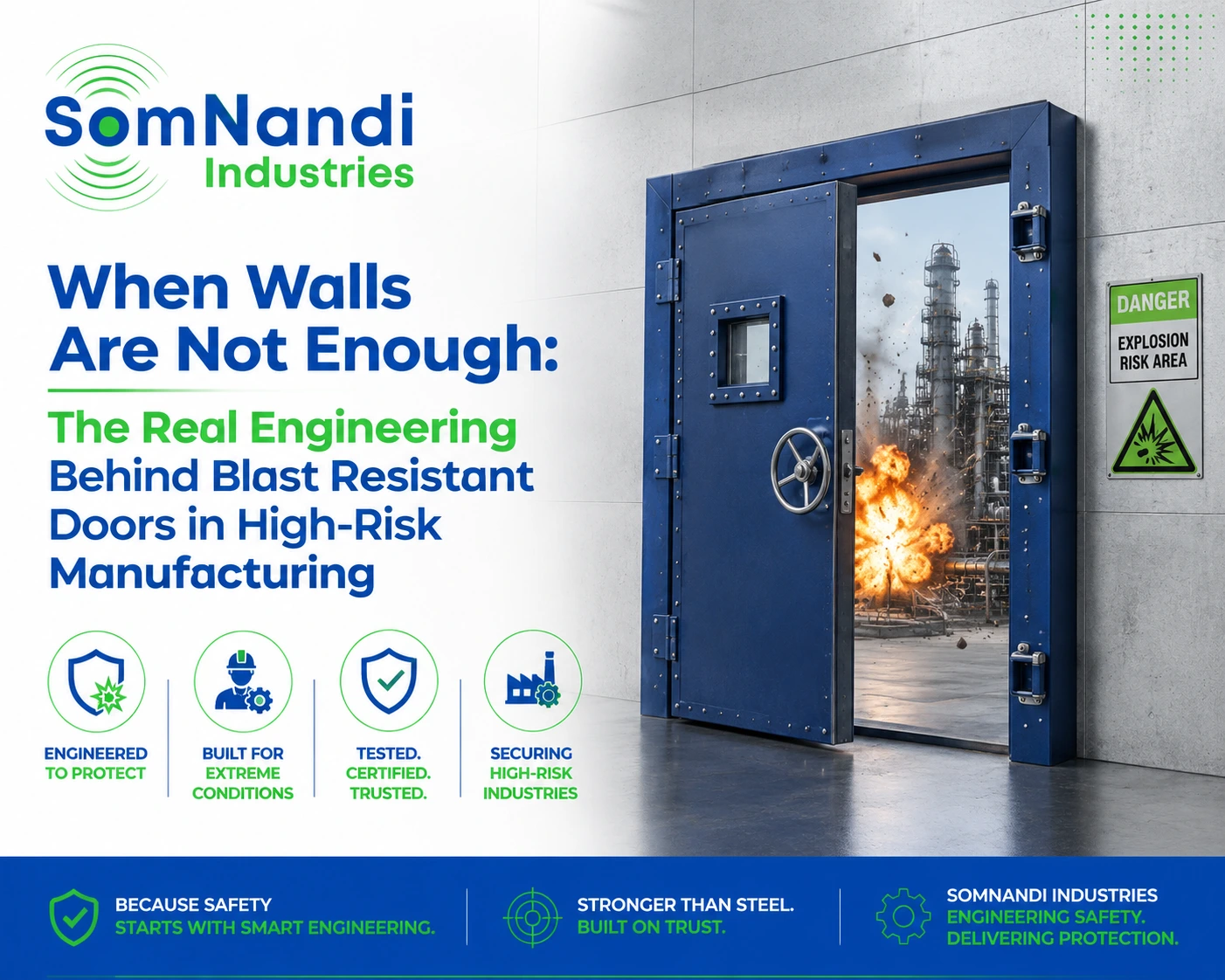
Walk through a refinery, a chemical processing unit, or a defense facility anywhere in India or across the globe, and you will notice something most visitors overlook. The doors. Not because they look flashy, because most of them do not. But because they are enormous, heavy, and clearly built to do something far beyond keeping a room private. These are blast resistant doors, and the story of how they are made, tested, and installed is one of the more quietly fascinating chapters in industrial safety engineering.
This is not a topic that comes up in casual conversation. But for the engineers, site managers, and procurement specialists working in high-hazard industries across India and internationally, it is one they think about very seriously. A door that fails during an explosion is not just a structural problem. It is a life-safety failure. So let us get into what actually goes into building one of these things and why it matters more than most people realize.
Why Ordinary Doors Have No Business Being in a Hazardous Zone
There is a common misunderstanding about blast protection. Many facilities assume that a heavy steel door, maybe a solid commercial security door with thick hinges, offers meaningful blast resistance. It does not. Not even close.
When an explosion happens, it produces a pressure wave that arrives in milliseconds and can generate overpressures of many times atmospheric pressure. A standard steel door, no matter how heavy it looks, will buckle, dislodge, or become a projectile. The frame will pull away from the wall. The hinges will shear. And the door itself, which was supposed to protect the people behind it, becomes part of the problem.
Blast resistant doors are designed around this physical reality from the very first drawing. The steel sections are sized for dynamic loading, not static. The frame is cast directly into the surrounding concrete so it cannot be pulled out. The hardware is rated not just for the door's weight but for the impulse loads that arrive when a shockwave hits. Every single detail including gaskets, hinges, locking bars, and threshold plates is engineered to work together as a system when things go catastrophically wrong.
What the Manufacturing Process Actually Involves
Building a blast resistant door is not like building a standard industrial door at a larger scale. The manufacturing process is genuinely different in almost every respect.
It starts with material selection. High-yield structural steel is the foundation and the grades matter enormously. The steel used in the door leaf, the frame, and the internal stiffeners all have to be specified based on the blast loading the door is designed to resist. You cannot simply grab whatever plate steel is available and start cutting.
Fabrication is all heavy weld work. The door leaf is typically a steel box section with two outer skin plates and internal stiffeners welded between them. Those welds are not cosmetic. Each one has to carry a portion of the blast load, and any porosity or incomplete fusion in the weld is a potential failure point. Reputable manufacturers use certified welders and conduct non-destructive weld inspection as a standard part of their process, not an optional add-on.
The frame assembly is equally critical. It has to anchor into the host structure with enough embedded depth that the blast load transfers cleanly into the surrounding wall rather than tearing the frame out. SomNandi Industries, which has deep experience in manufacturing blast resistant doors for industrial and defense applications across India and worldwide, designs its frames for cast-in-place installation. This means the frame goes into the formwork before concrete is poured, becoming structurally continuous with the wall itself.
After fabrication, the door assembly gets its hardware fitted. Hinges on a blast resistant door are not pivot pins. They are large, welded steel assemblies sometimes running almost the full height of the door because that is what it takes to transfer the rotational forces during a blast event without failure. Locking systems are not standard deadbolts either. They are multi-point locking bars that transfer load into the frame at multiple locations simultaneously.
Finally there is surface treatment and sealing. In chemical or gas processing environments, the door also needs to seal against pressure differential. That requires gaskets engineered to maintain contact even when the door leaf flexes under blast loading and they do flex by design. A door that cannot flex will crack or fracture. A door that flexes but whose seal breaks open introduces a whole new set of hazards.
Blast Proof Doors vs Blast Resistant Doors: Is There a Difference?
You will hear both terms used, blast proof doors and blast resistant doors, sometimes interchangeably and sometimes with strong opinions about the distinction. Here is the practical reality.
No door is truly blast proof in an absolute sense. Every door has a performance envelope, and above a certain pressure or impulse level, any door can be compromised. The term blast resistant is technically more accurate because it describes a door that resists blast loading up to a defined performance level rather than implying unlimited protection.
Blast proof doors in everyday usage typically refers to doors at the higher end of the performance spectrum. These are doors designed for close-range explosive threats, weapons scenarios, or very high overpressure environments. But the engineering principles are the same. What varies is the target performance level and the magnitude of the design loads.
SomNandi Industries manufactures doors across the full range of this spectrum, from units rated for relatively modest industrial overpressures to heavy blast proof doors designed for defense facilities, test ranges, and other high-threat applications both within India and across international project sites.
Blast Resistant Enclosures: When a Single Door Is Not the Whole Answer
Sometimes the requirement is not just for a protected doorway. Sometimes an entire room such as a control room, a communications hub, or an electrical equipment room needs to be built to withstand explosion effects on all sides. That is what a blast resistant enclosure is.
A blast resistant enclosure is essentially a hardened room within a building, or a standalone structure, where every surface including walls, ceiling, floor, and access points forms part of an integrated pressure-resistant system. In petrochemical plants across India and globally, it is extremely common to see the main control room built as a blast resistant enclosure. Operators working inside can monitor and respond to an emergency situation even while an explosion event unfolds in adjacent process areas.
The access points of a blast resistant enclosure are where the blast resistant doors come in. The enclosure is only as strong as its weakest opening, which is why the door specification has to match the wall specification. Installing a standard door into a blast resistant enclosure is like putting a plastic lock on a bank vault.
Blast Resistant Buildings: Designing Entire Facilities for Explosive Environments
At the largest scale, some facilities are designed as blast resistant building, structures where the entire architectural and structural design is driven by blast performance requirements. Every column, every beam, every wall thickness, and every connection is sized to survive a defined explosive load on any face of the building.
These are found in ammunition manufacturing, missile testing, defense logistics, offshore gas platforms, and similar environments across India and internationally. The engineering involved is complex and multidisciplinary. Structural engineers, blast consultants, MEP engineers, and specialist manufacturers all have to work in coordination. SomNandi Industries works alongside engineering teams on these kinds of projects both domestically and on international assignments, ensuring that the blast resistant doors specified for the facility meet the exact performance requirements of the building's overall blast design rather than just a generic standard that might miss the actual project requirement entirely.
The Role of Blast Resistant Barriers in a Layered Protection Strategy
Even in facilities with blast resistant buildings and blast resistant enclosures, there are situations where the explosion risk cannot be fully contained within a structure. Open-air process areas, loading bays, and outdoor storage zones still need some form of protection for adjacent personnel and equipment.
That is where blast resistant barriers come in. These are engineered structural panels or walls positioned to intercept and redirect blast energy before it reaches an asset or a person. They work on the principle of reflection and absorption. The wave hits the barrier and its energy is dissipated and redirected rather than transmitted through to the protected zone.
Blast resistant barriers are often used in combination with blast proof doors and blast resistant enclosures as part of a layered protection strategy. No single element handles everything. Each layer deals with a different portion of the threat, and together they provide a level of protection that no single component could offer alone. This approach is increasingly being adopted across industrial projects in India as well as in major international facility designs.
Choosing an Operating Mechanism That Fits the Job
One practical consideration that often gets overlooked until late in a project is how the door will actually be operated day to day. Blast resistant doors are heavy, sometimes very heavy, and manual operation may not be practical for every application.
SomNandi Industries supplies blast resistant doors with manual, hydraulic, pneumatic, and electric operating systems, selected based on the operational requirements of each specific installation. High-frequency access points in an active process plant might need electric or pneumatic actuation for efficiency. Emergency egress doors need to be manually operable from the inside regardless of what mechanism is fitted, so that power loss during an incident does not trap occupants.
Getting the operating mechanism right is as important as getting the blast rating right. A door that is difficult or slow to operate will either be left propped open, which negates its entire purpose, or become a bottleneck in emergency egress situations.
Who Actually Needs These Doors?
The list of industries where blast resistant doors are a genuine operational necessity is longer than most people expect. Oil and gas facilities. Chemical and petrochemical plants. Pharmaceutical research sites handling reactive compounds. Mining operations. Explosives manufacturing and storage. Military installations. Nuclear power plants. Industrial test facilities where propellants or energetic materials are handled.
In India, sectors like oil refining, defence manufacturing, and specialty chemicals are seeing growing demand for blast resistant doors, blast resistant enclosures, and blast resistant buildings as safety regulations strengthen and project complexity increases. Internationally, the same standards drive procurement decisions across the Middle East, Southeast Asia, Africa, and Europe.
The common thread is not the specific industry. It is the presence of materials or processes that can release large amounts of energy very quickly. Wherever that hazard exists, blast resistant doors, blast resistant barriers, blast resistant enclosures, and blast resistant buildings are part of how responsible operators manage their duty of care to workers, neighbors, and the environment.
The Bottom Line on Blast Resistant Door Procurement
There is no visible difference between a door that will perform correctly under blast loading and one that will not. They can look identical on a specification sheet and look identical on site. The difference is entirely in the engineering behind them, the material certifications, the weld quality, the frame design, the hardware ratings, and the testing data.
This is why manufacturer credibility matters enormously in this category. Whether a project is located in Mumbai, Chennai, or Delhi, or in a facility in the Middle East, Africa, or Southeast Asia, SomNandi Industries brings the same engineering depth, manufacturing quality, and installation expertise to every blast resistant door project. In an industry where a door's failure during an emergency is not an inconvenience but potentially a catastrophe, that consistency across every geography and every project scale is what sets a serious manufacturer apart.