
SomNandi Industries manufactures blast resistant partitions built on structural steel frames with Durasteel or Promatect board cladding, engineered to contain explosion overpressure while dividing functional areas inside petrochemical plants, power stations, and defense facilities. A blast resistant partition is an engineered internal wall system designed to withstand a specific blast overpressure and duration without structural failure, protecting personnel, equipment, and adjoining spaces on the non-blast side. This page is written for safety engineers, EPC contractors, and facility managers at petrochemical, power generation, and defense sites who need an internal blast barrier for buildings sized to an actual hazard assessment, not a generic fire-rated wall repurposed for blast duty.
Why Partition Design Cannot Copy Blast Door Specifications Directly
Blast resistant partitions share design logic with blast resistant doors, both are rated against overpressure and impulse duration, but a partition spans a much larger, often asymmetric area, which changes the engineering problem significantly. A door has a fixed, relatively small leaf size and a single load path through the frame. A partition wall has to distribute blast load across vertical steel members spaced to prevent localized panel failure, and the required spacing changes with partition height and whether the blast load is expected on one side or both sides of the wall. Specifying a partition using door-style thinking, uniform panel strength without checking member spacing against height, is the most common design gap we find when reviewing third-party layouts.
What Is a Blast Resistant Partition?
A blast resistant partition, also called a blast resistant wall or explosion resistant barrier, is an internal wall system engineered to absorb and resist the effects of explosions, serving as a significant obstacle protecting personnel, equipment, and structural integrity in high-risk industrial and defense environments. These partitions are engineered to standards similar to blast resistant doors and function as a core element in internal space division and control within explosion-prone areas. Unlike a standard partition wall, every structural member, panel, and finish detail on a blast resistant partition is selected specifically to meet a defined overpressure rating, not general building code minimums.
What Determines a Blast Resistant Partition's Design?
Short answer: Five site-specific parameters, not a fixed panel spec, drive partition design. Similar to blast resistant doors, blast resistant partition design is selected based on blast duration, partition height, vertical member spacing, blast load or pressure, and whether the blast is expected on one side or both sides of the partition.
| Design Parameter | What It Determines |
|---|---|
| Blast Duration | Peak overpressure time and structural response requirement |
| Height of Partition | Vertical reinforcement needed to maintain stability |
| Vertical Member Spacing | Even distribution of blast force, preventing localized failure |
| Blast Load or Pressure | Overpressure rating the assembly must survive, in bar or psi |
| Blast Direction | One-side or two-side loading, affecting material symmetry |
How Blast Duration and Overpressure Actually Shape the Structure
The total duration of the peak overpressure and blast phenomenon determines the structural requirements of the partition system, since a short, sharp impulse and a longer, lower-pressure event load steel members differently even at similar peak pressure. Taller partitions require increased vertical reinforcement to remain stable under pressure load, and vertical steel member spacing has to be set correctly to distribute blast forces evenly and prevent structural failure at the panel joints. Blast load design is guided by the expected overpressure rating, the resistance required against peak blast pressures, typically defined in bar or psi, referencing recognized blast design methodology rather than an assumed safety margin.
Technical Data Sheet
| Parameter | Specification |
|---|---|
| Product Name | Blast Resistant Partition / Blast Resistant Barrier |
| Frame | Heavy-duty structural steel |
| Partition Wall Board | Durasteel or Promatect cladding |
| Board Thickness | 9.5 mm typical, varies by blast rating |
| Finish | Shop-applied zinc-based primer, site paint ready |
| Fire Rating | Combined fire and blast rated options available |
| Loading Configuration | One-side or two-side blast direction rated |
| Deployment | Modular, new-build or retrofit into existing structures |
Specifications, Benefits, Applications and Installation Process for Blast Resistant Partition
Blast Resistant Partition vs Blast Resistant Wall: Same Thing?
In practice, yes, blast resistant partition and blast resistant wall describe the same category of internal structural barrier, though partition is used more often for internal space division within a building and wall is used more broadly, including perimeter or standalone blast protection structures. What matters more than the term used is whether the design accounts for your site’s actual blast load, direction, and duration rather than a generic fire-resistant wall specification.
Modular and Customizable Blast Protection
SomNandi Industries provides modular blast protection for buildings with partition systems tailored to the layout, height, and risk level of your facility. Whether integrated into a new build or retrofitted into existing infrastructure, our partitions are engineered for both structural security and layout adaptability, which matters most for facilities expanding or reconfiguring process areas without a full rebuild.
Integrated Fire and Explosion Protection
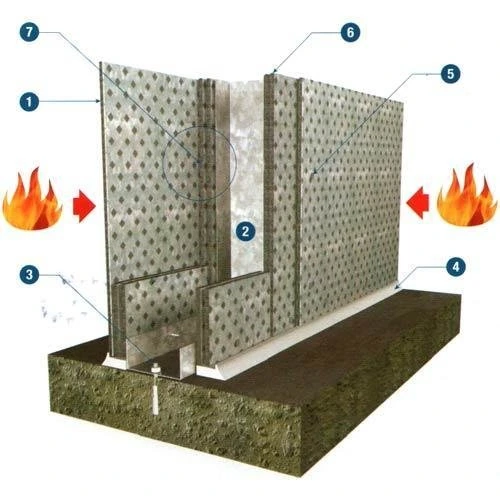
To provide dual-layer protection, SomNandi’s blast resistant partitions can also be rated for fire resistance, making them suited to environments where post-blast fire risk is a real concern rather than a secondary consideration. These combined fire and blast resistant partition systems protect personnel, support operational continuity, and maintain structural performance under extreme conditions where a fire-only or blast-only rated wall would not be sufficient.
Additional Protective Solutions for Your Safety
Alongside blast resistant partitions, SomNandi Industries offers modular blast barriers designed for flexible use in both temporary and permanent setups, bullet proof doors that stop ballistic threats while remaining fully functional, and bullet resistant enclosures that provide complete protection for personnel and sensitive equipment in high-risk areas.
Myth vs Reality
| Myth | Reality |
|---|---|
| Any fire-rated wall also resists blast loads | Blast rating requires separate overpressure design |
| Thicker boards always mean better blast resistance | Member spacing and height matter just as much |
| Partitions only work for one-side blast exposure | Two-side rated designs exist for symmetric loading |
| Blast partitions cannot be retrofitted | Modular systems fit into existing building layouts |
| Fire and blast ratings cannot combine in one wall | Combined fire and blast rated partitions are standard |
Frequently Asked Questions
What is a blast resistant partition used for?
What is the difference between a blast barrier and a blast partition?
What material is used in blast resistant partitions?
Can blast partitions also be fire rated?
How is blast partition design determined?
Can blast resistant partitions be retrofitted?
What industries use blast resistant barriers most?
What is the standard board thickness for blast partitions?
Do blast partitions protect against one-side or two-side blasts?
How are blast partitions finished for corrosion protection?
Get a Site-Specific Blast Resistant Partition Design
SomNandi Industries engineers blast resistant partitions for petrochemical plants, power stations, defense facilities, and hazardous storage areas across India. Share your hazard assessment, partition height, and blast direction requirement, and our engineering team will recommend the right frame, cladding, and fire rating combination for your site.