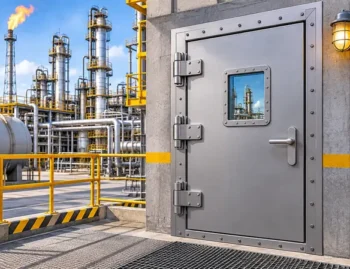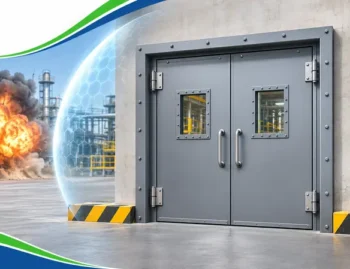
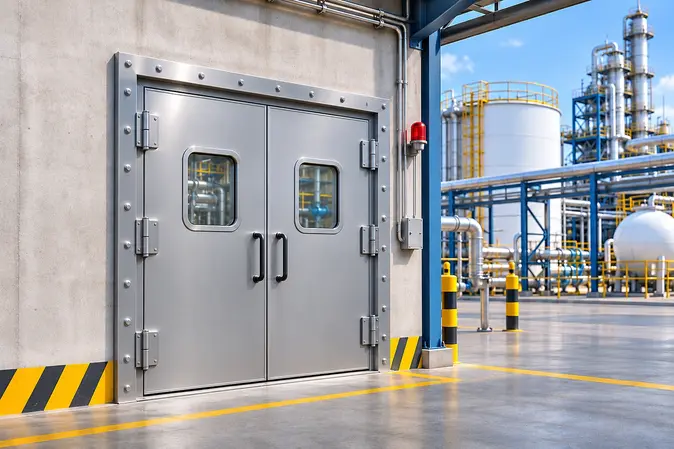
Blast resistant doors for chemical plants are engineered steel door assemblies. They protect critical openings from explosion pressure, flying fragments and fire. Every blast resistant doors chemical plant project starts with a site hazard assessment, because peak pressure and impulse duration differ from one facility to the next.
What Are Blast Resistant Doors for Chemical Plants?
Chemical plants handle flammable gases, reactive materials and high-pressure processes. Compressor rooms, control rooms and switchgear buildings need chemical plant safety doors that keep an explosion out and the opening sealed.
A door must also match the wall it sits in. A strong wall with a weaker door only moves the failure point to the opening. This is a core part of explosion protection in the chemical industry.
Refinery operators can read our guide on Blast Resistant Doors for Oil & Gas Refineries for a closely related use case.
What Are the Benefits of Steel Blast Doors?
Do blast resistant doors reduce echo?
Not as a primary function. These are protection products, not acoustic ones, and no echo reduction or NRC figure is published for them. For sound control, pair them with separate acoustic treatment.
Are blast proof doors easy to handle and install?
The process is structured and documented:
- Site hazard assessment and pressure rating confirmation
- Frame anchorage and wall interface review
- Fabrication of leaf, frame and hinge assembly
- Gasket fitting and on-site anchoring
- Commissioning and handover documentation
Doors can be operated manually, hydraulically, pneumatically or electrically, so daily use and emergency egress are both covered.
Where Are Anti Blast Doors Used?
Verified uses include petrochemical and refinery control rooms, switchgear buildings, chemical storage rooms, nuclear and defence facilities, and refuge areas. For the sectors below, a blast door is specified where a hazard assessment identifies explosion risk:
- Manufacturing and power plants
- Oil and gas facilities and gas refineries
- Water and wastewater plants
- Commercial buildings, data centres and hospitals
- Hotels, resorts and shopping malls
- Residential developments
- Airports, metro and railway facilities
- Educational campuses
What Affects the Price of Blast Resistant Doors?
The main factors are:
- Dimensions: larger openings need more material and stronger frames.
- Thickness: set by the required pressure rating and fire rating.
- Design: single or double leaf, hinged or sliding, and the type of operation.
- Quantity: project volume affects planning and fabrication.
- Installation: site conditions, frame anchorage and commissioning.
What Are the Blast Resistant Doors Specifications?
| Parameter | Specification |
|---|---|
| Peak reflected overpressure | Up to 40 bar |
| Fire resistance | Up to 180 minutes, BS 476 Part 20 and 22 |
| Configuration | Single leaf and double leaf |
| Maximum size | 4 m wide by 6 m high, custom sizes available |
| Operation | Manual, hydraulic, pneumatic or electric |
| Sealing | Single or multiple gasket systems |
| Special ratings | EMP protection and radiation shielding on request |
Why Choose a Blast Resistant Doors Manufacturer Like SomNandi?
As a Blast Resistant Doors Manufacturer, SomNandi Industries is ISO certified and reports 150+ projects delivered. Published work includes a successful installation at the IOCL Refinery, Panipat, and a fire-rated blast resistant double leaf steel door supplied to L&T. Our engineers design the door, frame and sealing as one system, which is what separates credible blast resistant doors manufacturers from generic steel door suppliers.
Frequently Asked Questions:
What is the purpose of blast resistant doors?
They protect openings from explosion pressure, debris and fire, and keep the space behind them sealed.
How much do blast resistant doors cost?
Pricing depends on pressure rating, size, thickness, design, quantity and installation. Share your requirement for a quotation.
Are blast proof doors soundproof?
No sound reduction figure is published for them. For acoustic performance, ask us about dedicated acoustic doors.
Where are blast resistant doors used?
In chemical, petrochemical, oil and gas, power, defence and other facilities where a hazard assessment shows explosion risk.
Are they made from recycled materials?
Recycled content is not stated in our published product data, so we make no claim. Please confirm it with our team.