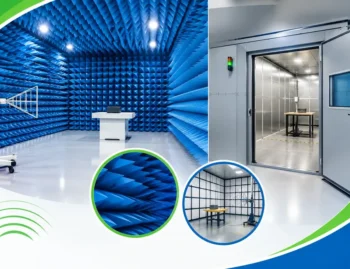
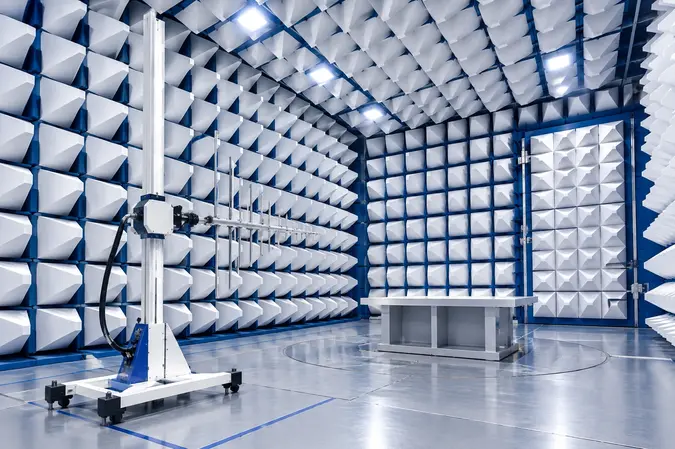
An EMC chamber is a shielded, absorber-lined room that lets engineers measure the electromagnetic energy a product emits and check that it keeps working when exposed to outside interference. Compliance is demanded by standards such as CISPR, IEC/EN, MIL-STD-461 and RTCA DO-160, as well as regional rules like BIS and FCC. If you are comparing EMC chamber manufacturers in India, it helps to understand how these rooms are built and why they differ.
What “Anechoic” Actually Means
The word comes from the Greek an- (without) and echo. In acoustics it describes a room with no reflections. In EMC work the same idea applies to radio waves.
An anechoic chamber is an enclosure whose internal surfaces absorb almost all incident energy, so the only signal the instrument sees is the one coming directly from the device under test.
An Everyday Analogy
Shout in an empty tiled hall and the echo muddles what you hear. Shout in a room with thick curtains and foam panels and the sound dies almost at once. An EMC chamber does this for radio frequencies. The metal shell works like a soundproof wall that keeps outside noise out, and the absorbers work like the foam that stops reflections inside. A “Sound Absorption Anechoic Chamber” uses the same principle for acoustic energy, and some labs combine both when they test products for noise and EMI together.
Where EMC Chambers Are Used
Automotive, aerospace and defence, medical devices, telecom, and consumer electronics are the main users. Each sector follows different standards, which drives different chamber layouts. Automotive labs need space for a full vehicle or an ALSE setup. Aerospace and defence work calls for wide frequency coverage and high field strengths. Medical and consumer labs usually need a compact room for emissions and radiated immunity testing.
Common Chamber Types and Uses
The most common formats are the semi-anechoic chamber (3 m or 10 m) for radiated emissions, the fully anechoic chamber for radiated immunity and antenna work, the shielded room for conducted and ESD testing, the automotive component (ALSE) chamber, the vehicle-level chamber, and the military or avionics chamber. A reverberation chamber is another option for high-field immunity. A semi-anechoic room has a reflective floor to simulate open-area test conditions. A fully anechoic room lines the floor with absorber as well.
Standards and Typical Specifications
Commercial emissions testing generally follows CISPR 32 (EN 55032) or CISPR 11, measured from 30 MHz to 1 GHz and often extended to 6 GHz. Chamber performance is verified by normalized site attenuation, with a tolerance of ±4 dB under CISPR 16-1-4. Radiated immunity under IEC 61000-4-3 is typically run from 80 MHz to 6 GHz, with field uniformity checked on a 16-point grid.
Automotive work uses CISPR 25 and ISO 11452-2, covering roughly 150 kHz to 2.5 GHz and beyond. Military and avionics labs apply MIL-STD-461 (RE102 and RS103) and RTCA DO-160 Sections 20 and 21, often up to 18 GHz. Medical devices are tested to IEC 60601-1-2. Shielding effectiveness is commonly specified at 80 to 100 dB or better across the band, and is verified using methods such as IEEE 299 or EN 50147-1.
RF SHIELD TECHNOLOGY
The shield is a continuous conductive envelope, usually welded or bolted galvanized steel, copper or aluminium panels. Its job is to stop external signals from contaminating measurements and to keep strong test fields inside. Any gap or poor seam creates leakage, so the door is the most critical component. RF doors typically use knife-edge or finger-stock contacts that press against a conductive frame.
Every penetration needs treatment. Power and signal lines pass through filters, ventilation uses honeycomb waveguide-below-cutoff panels, and fibre-optic or process lines use waveguide tubes. Inside, carbon-loaded pyramidal foam absorbers handle higher frequencies, while ferrite tiles extend performance down toward 30 MHz. Hybrid designs combine the two to save space. Good absorber systems typically reach reflectivity of around −20 dB or better at lower bands, and −40 dB or better at higher frequencies.
Practical tip: Plan for door and filter maintenance from day one. In our experience, most shielding degradation over the years comes from worn or dirty finger-stock and oxidised contact surfaces, not from the walls. A simple periodic leakage check will catch this early and protect your accreditation.
Choosing the Right Partner
Are you in the process of installing or choosing an EMC chamber? Don’t hesitate to contact us. Our account managers and technical experts can guide you from site survey to commissioning, even if you are still unsure which standards, frequency range or size you need. A short conversation about your products and target markets is often enough to define the right configuration with the right EMC chamber manufacturers.