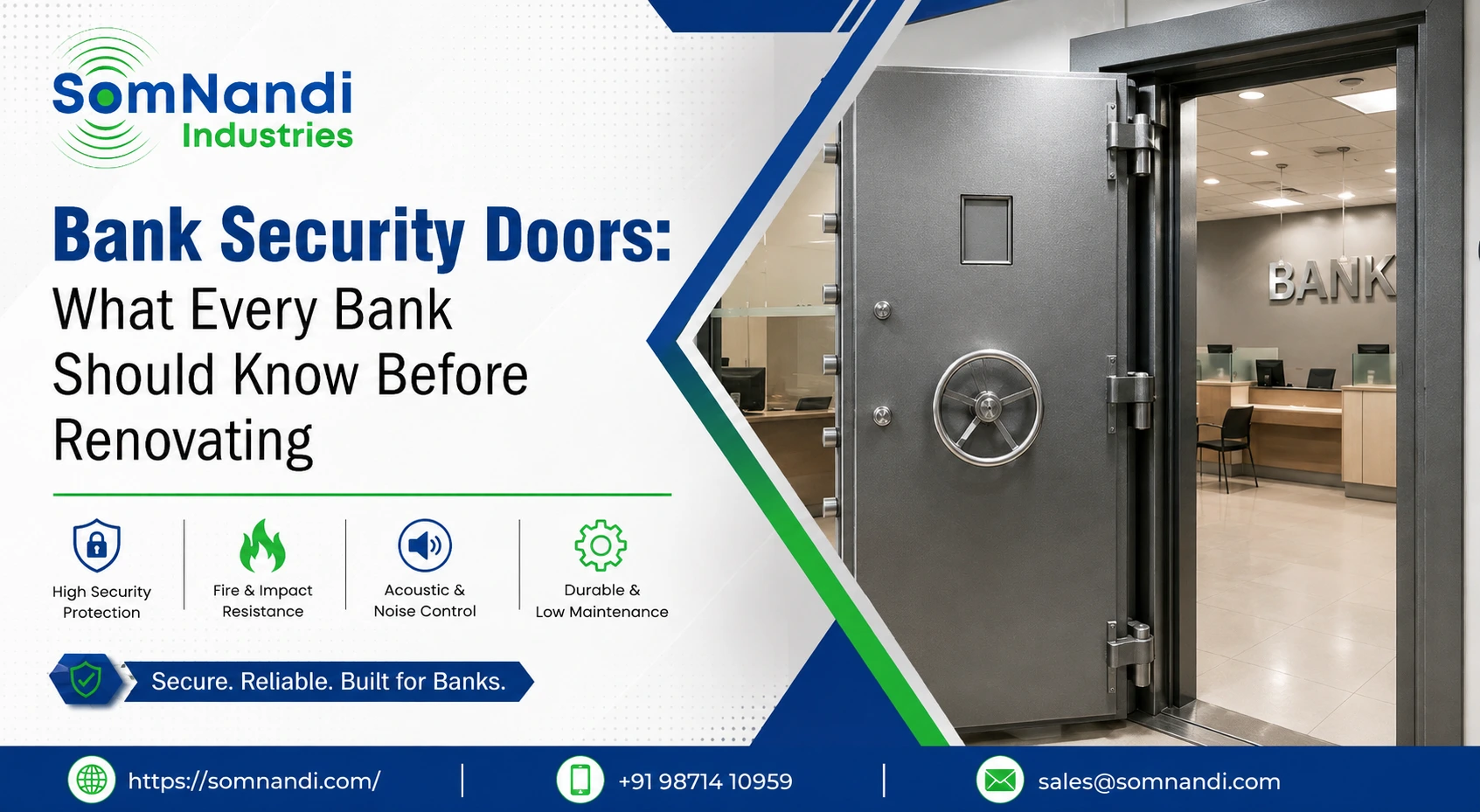
Renovation season at a branch usually starts with paint colors and furniture layouts, and somewhere in the middle of that punch list, security gets tacked on almost as an afterthought. That's backwards. The doors protecting your teller line, your cash room, and your drive-through window aren't a finishing touch — they're the part of the project that actually determines what happens if someone tries to walk through them uninvited.
At SomNandi Industries, we work with bank and facilities teams who are usually mid-renovation when they realize their existing bank security doors are either outdated, under-rated for current risk, or were never specified correctly to begin with. This guide covers what to actually look at before you sign off on a security upgrade — teller lines, cash rooms, drive-throughs, and the deterrence value of the doors themselves.
Why Bank Security Doors Deserve More Than an Afterthought
A branch renovation is expensive enough without treating security as a line item you circle back to later. Bank security doors sit at every point where cash, employees, and the public come close together — and those are exactly the points a bad actor is planning around before they ever walk in.
Here's the thing most people don't realize until they're deep into a renovation: swapping out a standard hollow-metal bank security doors for a properly rated one isn't a simple substitution. Frame anchoring changes, hardware requirements change, and in some cases the wall assembly around the opening needs reinforcement too. If security gets bolted on at the end of the project instead of planned from the start, you end up either compromising on the spec or paying to redo work that was already finished.
Teller Line Doors: The First Thing Worth Reassessing
The teller line is usually where robbery risk is highest and where the existing doors are most likely to be outdated. Older branches often have doors rated for basic forced entry but nothing close to bullet resistant bank doors — a gap that becomes obvious the moment an incident actually happens.
A few things worth checking during renovation planning:
- Rating level. Is the current door actually rated against firearms, or just against prying and basic break-ins? These are not the same thing, and older installations frequently get this wrong.
- Access control integration. Modern bank security doors need to work with card readers, buzzer systems, and remote release — retrofitting that into an old door assembly is often more trouble than starting with a door designed for it.
- Line of sight. Tellers need visibility to spot trouble early, which means glazing matters as much as the door panel itself.
Cash Room Access: Where the Stakes Are Highest
If the teller line is the front line, the cash room is the vault behind it — sometimes literally. Cash room doors typically need a higher rating than teller line doors, since this is the space with the most concentrated financial exposure in the building.
Bank renovating this space should pay attention to a few specifics: dual-authentication access control, door position sensors tied into the alarm system, and hardware that can withstand repeated daily use without the seal or rating degrading over time. It's a mistake to assume a bank security doors installed once will perform the same five years later — hinges wear, seals compress, and hardware gets replaced with whatever's on hand during a routine maintenance call unless someone's specifically tracking it.
Drive-Through Windows: An Easy Point to Overlook
Drive-through lanes get a lot of attention for customer convenience and almost none for security, which is exactly backwards given how exposed they are. The transaction window sits at the boundary between a public space — a car, at that — and the interior of the branch, often with less oversight than the teller line inside.
Bank security doors aren't limited to swinging or sliding doors in the traditional sense; drive-through pass-through systems and transaction drawers fall under similar ballistic considerations. If your renovation touches the drive-through at all, this is worth specifying alongside the interior doors rather than treating it as a separate, lower-priority item.
Robbery Deterrence Isn't Just About the Rating
Here's something worth sitting with: a lot of the security value in bank security doors comes from what a potential robber sees before anything happens, not just what the door can withstand if it does. Visible, well-maintained, professionally installed security doors signal that a branch has invested in protection — and that alone changes the calculation for someone casing a location.
This is part of why cutting corners on appearance to save on cost tends to backfire. A door that looks makeshift or improvised undercuts the deterrence value even if the underlying rating is solid. Renovation is the moment to get both right at once, since you're already touching the space.
What to Ask Before You Finalize the Renovation Plan
A few questions worth raising with your security vendor and contractor before renovation work locks in:
- What UL 752 rating does this space actually need, based on branch location, past incident history, and cash volume — not just a generic industry default?
- Does the frame and wall assembly support the door's rating, or does the surrounding structure need reinforcement too?
- How will access control and alarm systems integrate with the new doors, rather than being bolted on after installation?
- What's the maintenance plan for keeping hardware and seals performing at their rated level over time?
- Does the installer have experience specifically with bank security doors, or is this a generalist commercial bank security doors contractor taking on something outside their usual scope?
Final Thoughts
A branch renovation is the best window you'll get to fix security gaps that have been sitting there for years — because the walls are already open, the contractor's already on-site, and the cost of doing it right goes up dramatically once the project wraps and everything's buttoned up again. Getting bank security doors right at the teller line, the cash room, and the drive-through isn't just about meeting a rating on paper. It's about making sure the branch is actually harder to target in the first place.
If a renovation is on your calendar, SomNandi Industries can walk your branch with you and map out exactly where bullet resistant bank doors belong — and where they don't. Reach out for a security assessment before your renovation plans are finalized.
Frequently Asked Questions
No. Bullet resistant bank doors are typically specified for high-exposure points — teller lines, cash rooms, and sometimes drive-through systems — rather than every door in the building. A proper risk assessment determines where the higher rating is actually necessary.
It depends on the current door and frame. In some cases, hardware and glazing upgrades can improve performance without full replacement. In others — particularly where the frame or wall assembly can't support a higher rating — full replacement is the more reliable option.
Most branches benefit from at least an annual inspection covering hardware function, seal condition, and alarm/access control integration, with more frequent checks on high-use doors like the teller line.
Requirements vary by jurisdiction and institution type — some regulators or insurers set minimum expectations, but many decisions come down to the branch's own risk assessment rather than a blanket mandate. Check with your compliance team and local requirements before finalizing a spec.
It can, particularly around opening force and clearance width, which is why doors need to be specified as a full system rather than swapped in isolation. This should be reviewed alongside your architect or code consultant during renovation planning.