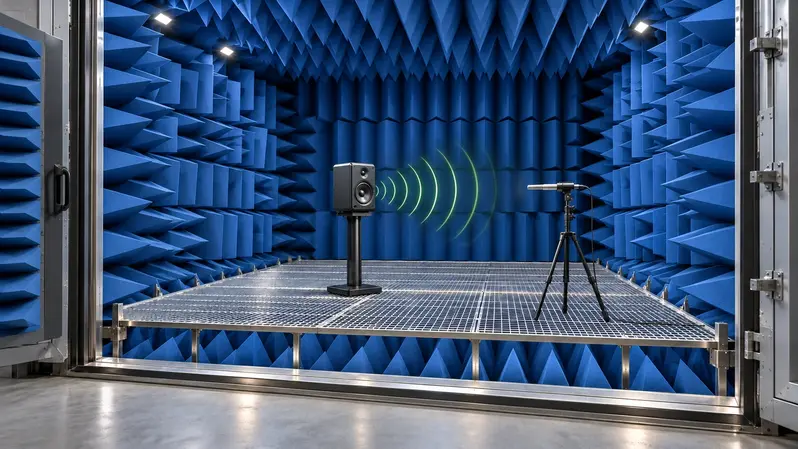
An anechoic chamber is a specially built room that absorbs sound or electromagnetic waves instead of reflecting them, creating a controlled, echo-free test environment. Engineers use it to measure the emissions, immunity, antenna performance or acoustic output of a product without interference from the room or the outside world. Testing inside one is governed by standards such as CISPR, IEC/EN, MIL-STD-461 and RTCA DO-160.
What Does "Anechoic" Mean?
The word comes from the Greek an- (without) and echo, so it literally means "without echo." The term was first associated with acoustic testing, but today it covers radio-frequency (RF) rooms too. An anechoic chamber is an enclosure whose internal surfaces are lined with absorbing material so that almost no sound or radio energy is reflected back toward the test object.
You will also hear the same room called an acoustic chamber, a silent chamber or, in its RF form, an EMC Chambers. The name changes with the discipline, but the principle stays the same.
A Simple Analogy
Shout in a large empty hall and you hear your voice return a moment later. That is the room talking back. Now imagine the same hall with every wall, floor and ceiling covered in thick foam. Your voice dies away almost instantly, because nothing sends it back.
An anechoic chamber does this deliberately. The absorbing lining removes reflections, so the only signal a microphone or antenna picks up is the one coming directly from the device under test. For radio waves, the room also works in reverse: a metal shield keeps outside signals out, much like a closed door keeps street noise away.
Where Anechoic Chambers Are Used
Automotive, aerospace and defence, medical devices, telecom, consumer electronics, and industrial equipment manufacturing all rely on this kind of testing. A smartphone maker checks antenna patterns, a hospital-equipment supplier proves its device does not disturb nearby monitors, and an avionics team qualifies hardware before certification.
Different standards lead to different designs. A vehicle test needs a large room with a turntable and a heavy-duty floor, while a wearable device can be tested in a compact bench-top enclosure. Military and aerospace rules often call for lower frequencies and higher shielding levels than commercial product standards.
Main Types and Common Uses
Most projects fall into one of these categories: fully anechoic chambers, semi anechoic chambers, EMC test chambers, antenna measurement (compact range) chambers, acoustic and sound-power chambers, and compact shielded test enclosures.
A fully anechoic room lines all six surfaces with absorber and suits antenna and radar work. A semi anechoic chamber keeps a reflective, conductive floor to mimic an open-area test site, which is how most commercial emissions testing is done. Acoustic versions are built as isolated rooms for measuring noise from products such as appliances and engines.
Standards and Technical Specifications
For commercial EMC work, CISPR 16-1-4, CISPR 32 and the EN 55032 family define emission measurement methods and site validation. IEC/EN 61000-4-3 covers radiated immunity, and requires a uniform field across the test area. Military programs refer to MIL-STD-461, and avionics qualification to RTCA DO-160. For acoustics, ISO 3745 describes sound power measurement in anechoic and hemi-anechoic rooms.
Typical figures give a useful benchmark when comparing quotes. EMC chambers commonly operate from 30 MHz to 18 GHz or higher, with shielding effectiveness of 80 to 100 dB or more. Site validation targets a normalized site attenuation within ±4 dB, and the field uniformity requirement is a tolerance of 0 to 6 dB. In acoustic rooms, background noise is often below 20 dBA, with a cut-off frequency in the region of 63 to 100 Hz. Always confirm exact values against the standard that applies to your product.
HOW SOMNANDI INDUSTRIES BUILDS AN ANECHOIC CHAMBER
At SomNandi Industries, an anechoic chamber is built in layers. A welded or modular steel shell forms the shield. Inside it, absorbers are fixed to the walls and ceiling: pyramidal or wedge-shaped foam loaded with carbon for RF rooms, and acoustic wedges for sound rooms. Ferrite tiles are often added at lower frequencies, where foam alone is not enough.
The details at the boundary decide performance. RF doors use spring-finger contacts to keep shielding intact when closed, while power and signal lines pass through filters so noise cannot travel in along cables. Ventilation uses waveguide-below-cutoff honeycomb panels, which let air through but stop radio energy. A well-built absorber lining reaches reflectivity of around -40 dB at higher frequencies.
One practical tip: decide on the largest equipment, door opening, turntable load and cable routes early. Changing a door size or a floor rating after the shell is built is far more expensive than planning for it at the start. It also pays to specify the highest test frequency you may need in the next few years, not only today.
Typical figures give a useful benchmark when comparing quotes. EMC chambers commonly operate from 30 MHz to 18 GHz or higher, with shielding effectiveness of 80 to 100 dB or more. Site validation targets a normalized site attenuation within ±4 dB, and the field uniformity requirement is a tolerance of 0 to 6 dB. In acoustic rooms, background noise is often below 20 dBA, with a cut-off frequency in the region of 63 to 100 Hz. Always confirm exact values against the standard that applies to your product.
Planning Your Installation
Are you in the process of installing or choosing an anechoic chamber? Don't hesitate to contact us. Our account managers and technical experts can help you even if you are not yet sure which standard, size or configuration you need. We can start from your product and test plan and work out the right specification from there.