Summary: Anyone who has sat in a large hall struggling to understand a speaker over echo and muddled reverberation knows exactly why acoustic panels for auditorium spaces matter. Sound is the core of the auditorium experience, whether it is a keynote address, a classical performance, or a school assembly, and when reverberation runs uncontrolled, even the best sound system cannot rescue clarity. Acoustic panels for auditorium interiors absorb and manage these reflections at the source, giving every word and note a fair chance of reaching the audience intact.
What Is Speech Intelligibility and Why Does It Depend on x Acoustics?
Speech intelligibility refers to how clearly spoken words can be understood by a listener, and it is directly affected by reverberation time, background noise, and how sound reflects off hard surfaces. In an untreated auditorium, sound waves bounce repeatedly off bare walls, ceilings, and floors before they decay, layering delayed reflections on top of the original speech and blurring consonants and syllables.
This is measured objectively using the Speech Transmission Index, a standardized scale from 0 to 1 where higher value indicates clearer, more understandable speech. Auditoriums with excessive reverberation typically score poorly on this scale, which is exactly the problem that acoustic panels for auditorium interiors are designed to correct.
How Do Acoustic Panels for Auditorium Spaces Actually Improve Sound Clarity?
Acoustic panels absorb sound energy rather than letting it reflect indefinitely around the room. When installed on walls, ceilings, and other reflective surfaces, they shorten reverberation time by converting sound energy into small amounts of heat within the panel's core material, which reduces the layering of delayed reflections that muddy speech and music.
The effectiveness of any panel is measured by its Noise Reduction Coefficient, a rating that indicates how much sound energy the material absorbs across key frequency bands. Auditorium sound panels with a higher NRC absorb more sound, which translates directly into clearer speech, better musical definition, and fewer dead spots or hot spots across the seating area.
What Types of Auditorium Acoustic Materials Are Commonly Used?
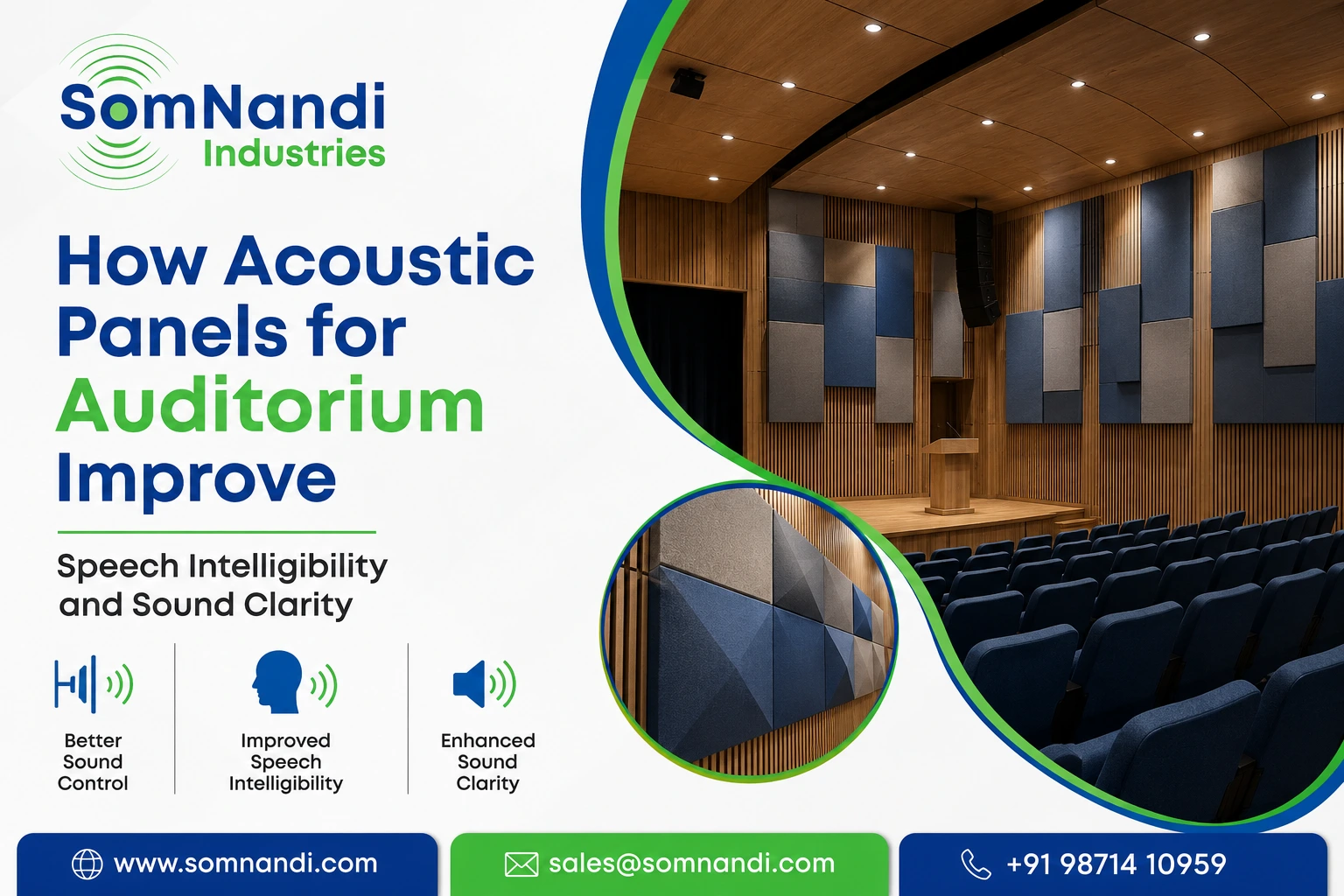
Different auditorium acoustic materials serve different purposes depending on where they are installed and what frequency range needs control, and choosing the right acoustic panels for auditorium spaces starts with understanding these options. The most common choices include:
- Fabric-wrapped acoustic panels: These combine a rigid core with a breathable fabric finish, offering strong mid to high frequency absorption while maintaining a clean, architectural appearance.
- Perforated wooden panels: Popular for acoustic wall panels for auditorium interiors where visual warmth matters, these combine acoustic performance with a natural finish suited to concert halls and performance spaces.
- Foam-based panels: Used for targeted absorption in specific zones, particularly where budget or installation flexibility is a priority.
- Ceiling clouds and baffles: Suspended elements that address ceiling-borne reverberation in high-volume spaces without requiring a full ceiling treatment.
Selecting the right combination of auditorium acoustic materials depends on the room's volume, seating capacity, and primary use, since a lecture hall and a concert auditorium have very different reverberation targets.
Why Does Auditorium Wall Panelling Matter as Much as Ceiling Treatment?
Auditorium wall panelling plays a critical role because side walls are often the first reflective surfaces sound encounters after leaving the stage or podium. Untreated side walls can create strong early reflections that arrive at the listener's ear just after the direct sound, which the brain perceives as blurring rather than reinforcement.
Strategic placement of acoustic wall panels for auditorium side and rear walls breaks up these early reflections, particularly in the rear third of the hall where echo is most noticeable. Combined with ceiling treatment, wall panelling ensures that sound energy is absorbed and diffused evenly rather than concentrated in a few problem zones.
What Auditorium Ceiling Material Works Best for Large Volume Spaces?
Large auditoriums present a unique challenge because ceiling height increases the distance sound waves travel before reflecting back down, creating pronounced reverberation if left untreated. The right auditorium ceiling material needs to balance acoustic absorption with the practical demands of lighting, rigging, and HVAC integration.
Suspended acoustic ceiling clouds and vertical baffles are commonly used as auditorium ceiling material in high-volume halls, since they target ceiling-borne reflections without requiring a continuous acoustic ceiling that could interfere with technical infrastructure. This approach also allows architects to preserve visual openness while still meeting reverberation time targets.
What Does a Complete Acoustic Treatment for Auditorium Projects Include?
A thorough acoustic treatment for auditorium spaces goes beyond wall and ceiling panels alone. It typically includes diffusers and reflectors to spread sound evenly and eliminate dead zones, stage-specific treatment such as rear-wall absorption and floor insulation to support live performance clarity, and mechanical noise isolation to control HVAC and equipment noise that would otherwise interfere with speech intelligibility.
Acoustic modeling using tools such as EASE, CAD, and BIM allows designers to simulate how sound will behave in the space before installation begins, which reduces costly guesswork and ensures the final acoustic treatment for auditorium interiors performs as intended once the hall is in use.
How Does SomNandi Industries Approach Auditorium Acoustic Design?
SomNandi Industries brings more than 25 years of experience to auditorium acoustic projects across India, with in-house manufacturing of acoustic panels for auditorium and performance space applications, and a track record of over 100 completed auditorium acoustic treatment projects. Every project combines fabric-wrapped panels, perforated wooden panels, ceiling clouds, diffusers, and stage acoustic treatment tailored to the specific hall, backed by acoustic modeling to validate performance before installation.
A recent example is the 500-seater auditorium project completed at the Assam Rifles headquarters in Shillong, where SomNandi Industries delivered a complete acoustic treatment designed to eliminate echo and ensure clear audio for strategic briefings and formal events. SomNandi Industries holds ISO 9001 and ISO 14001 certification, and uses environmentally friendly, fire-safe materials across its auditorium acoustic panel and soundproofing systems.
Conclusion
Clear speech and rich sound in an auditorium are not the result of a powerful sound system alone, they depend on how well the room itself controls reverberation, echo, and reflection. Acoustic panels for auditorium walls and ceilings, combined with diffusers, stage treatment, and mechanical noise isolation, work together to give every seat in the house a clear, balanced listening experience. SomNandi Industries applies decades of acoustic engineering expertise to design and install these systems for auditoriums of every size, ensuring every voice is heard the way it was meant to be.
Frequently Asked Questions
It depends on room volume and current reverberation time, which is why acoustic modeling is used to calculate the exact coverage needed before installation.
Acoustic panels mainly control internal reverberation, while soundproofing measures like sealed doors and insulated walls handle external noise isolation.
Most speech-focused auditoriums target a reverberation time under 1.5 seconds, though the ideal figure varies with room size and use.
Yes, fabric-wrapped and perforated wooden panels are widely used precisely because they combine sound absorption with an architecturally finished look.
Both matter, but side and rear wall treatment often has the biggest impact on early reflections that directly affect speech intelligibility.
SomNandi Industries designs and installs acoustic panels for auditorium, concert hall, and performance space projects across India, backed by over 25 years of acoustic engineering experience. Contact SomNandi Industries to discuss an acoustic treatment plan for your auditorium.