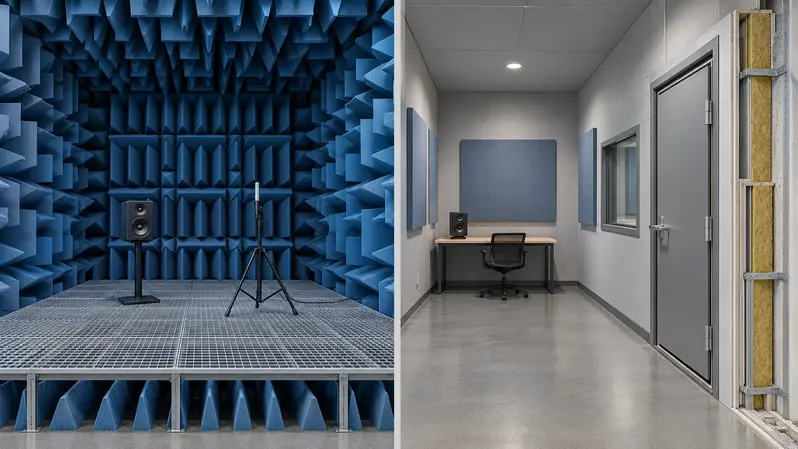
An anechoic chamber is a test enclosure that absorbs nearly all sound or radio-frequency reflections from its internal surfaces, creating a free-field environment for accurate measurement. A soundproof room does something different: it stops noise from passing between the room and its surroundings. The two are often confused, and the difference matters when you specify a facility. Acoustic anechoic chambers are qualified against standards such as ISO 3745 and ISO 26101, while soundproofing performance is rated under ISO 10140 and ASTM E90.
What “Anechoic” Actually Means
The word comes from the Greek an- (without) and echo. An anechoic space is literally an “echo-free” space. An anechoic chamber is a room whose boundaries absorb sound so completely that a source inside behaves as if it were in open air with no walls at all.
A soundproof chamber is defined by a different property: transmission loss, meaning how much sound energy fails to pass through its walls, floor and ceiling.
A Simple Way to Picture It
Shout in a large empty hall and you hear your voice return from the walls. That is reflection. Now shout into a thick, heavy curtain, and the sound is swallowed. That is absorption, and it is the principle behind an anechoic room.
Next, imagine closing a heavy door to keep a noisy street out. That is isolation, the principle behind a soundproof room. One controls what happens inside the space; the other controls what crosses its boundary. Most serious test facilities need both.
Where These Chambers Are Used
Automotive, aerospace, medical devices, telecom, consumer electronics, defence and audio equipment manufacturing all rely on controlled acoustic environments. The configuration depends on the standard the product must meet. A hearing-aid manufacturer needs low-frequency accuracy and very low background noise. An automotive supplier running NVH tests needs a large hemi-anechoic space with a reflective floor and often a dynamometer. A telecom lab needs an RF-focused design.
Common Types and Uses
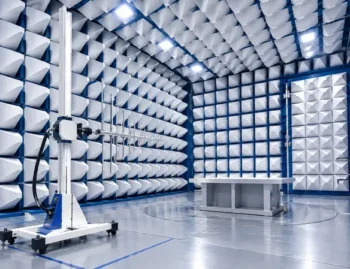
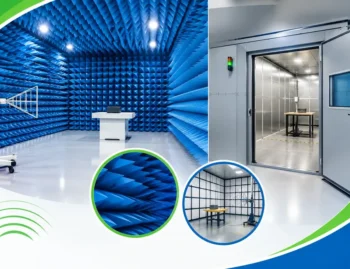
The main configurations are full anechoic chambers, hemi-anechoic chambers, reverberation rooms, sound-insulated test booths, NVH test labs and audio Anechoic Chamber Work for speaker and microphone calibration. Machinery noise testing usually calls for a hemi-anechoic layout, since equipment sits on a hard floor. Microphone and loudspeaker work favours a full free-field room, where every surface, including the floor, is lined with absorbers.
Standards and Typical Specifications
For acoustic work, ISO 3745 covers sound power measurement in anechoic and hemi-anechoic rooms, and ISO 26101 covers qualification of free-field test environments. ISO 354 governs reverberation-room absorption tests, and ISO 10140 covers laboratory measurement of sound insulation. For electromagnetic chambers, the relevant standards include CISPR 16-1-4, IEC 61000-4-3, MIL-STD-461 and RTCA DO-160 Section 20.
Typical acoustic targets include a lower cut-off frequency of 50 to 100 Hz, absorption above 99% at and above that cut-off, and background noise at or below NR 20. A soundproof room is usually specified by its sound transmission class (STC), with values of 50 to 60 or higher common for test enclosures.
ACOUSTIC ANECHOIC CHAMBER DESIGN: HOW IT WORKS
Good acoustic chamber design starts with the lowest frequency you need to measure accurately. This sets the length of the anechoic wedge, the shaped absorber lining the walls and ceiling. As a rule of thumb, wedge length should be at least a quarter of the wavelength at the cut-off frequency. At 100 Hz that is roughly 0.85 m, and a 63 Hz cut-off needs wedges of around 1.35 m.
The wedges are typically made of fibreglass or mineral wool, and their tapered shape gradually matches impedance so sound enters the material rather than bouncing off it. Behind them sits a heavy, decoupled shell, usually double-wall construction on vibration isolators. This is the soundproofing layer that keeps outside noise out. Add acoustically treated doors, silenced ventilation and a mesh floor (for full anechoic rooms), and you have a sound absorbing chamber that is both quiet and free of reflections.
Practical tip: do not size a chamber around the product alone. Account for the measurement distance, microphone arrays, fixtures and operator access, and keep a safe distance from the wedge tips. Resizing after construction is expensive, whereas a few extra metres at the design stage cost relatively little.
Choosing the Right Solution
Are you in the process of installing or choosing an anechoic chamber? Don’t hesitate to contact us. Our account managers and acoustic experts can help you even if you are unsure whether you need an anechoic chamber, a soundproof room or a combination. Share your product, test standard and frequency range, and we will help you define a workable specification.