Summary - Every growing office eventually asks the same question: do we need more meeting rooms, or is it time to rethink the space altogether? They have long been the default answer for group discussions, client calls, and team huddles, but a fixed enclosed space is not always the most practical or cost-effective option. As offices shift toward flexible, activity-based layouts, many businesses are comparing traditional booked spaces with modern alternatives like the work pod and the meeting pod to see which one actually supports the way people collaborate today.
What Are Meeting Rooms and Why Do Offices Still Rely on Them?
Meeting rooms are enclosed, permanent spaces built specifically for group discussions, interviews, and presentations. They typically include a table, seating for several people, and audiovisual equipment for calls and screen sharing. For decades, this type of space has been the standard solution whenever a company needed privacy away from the open floor.
Their strength lies in formality and capacity. Larger conference spaces can comfortably host board discussions, client presentations, and training sessions that a compact pod simply cannot accommodate. However, they require construction, come with fixed dimensions, and cannot be relocated once built. In fast-changing offices, this lack of flexibility often becomes a real limitation, especially when teams only need a quiet corner for fifteen minutes rather than a full conference setup.
What Is a Work Pod and How Is It Different from Meeting Rooms?
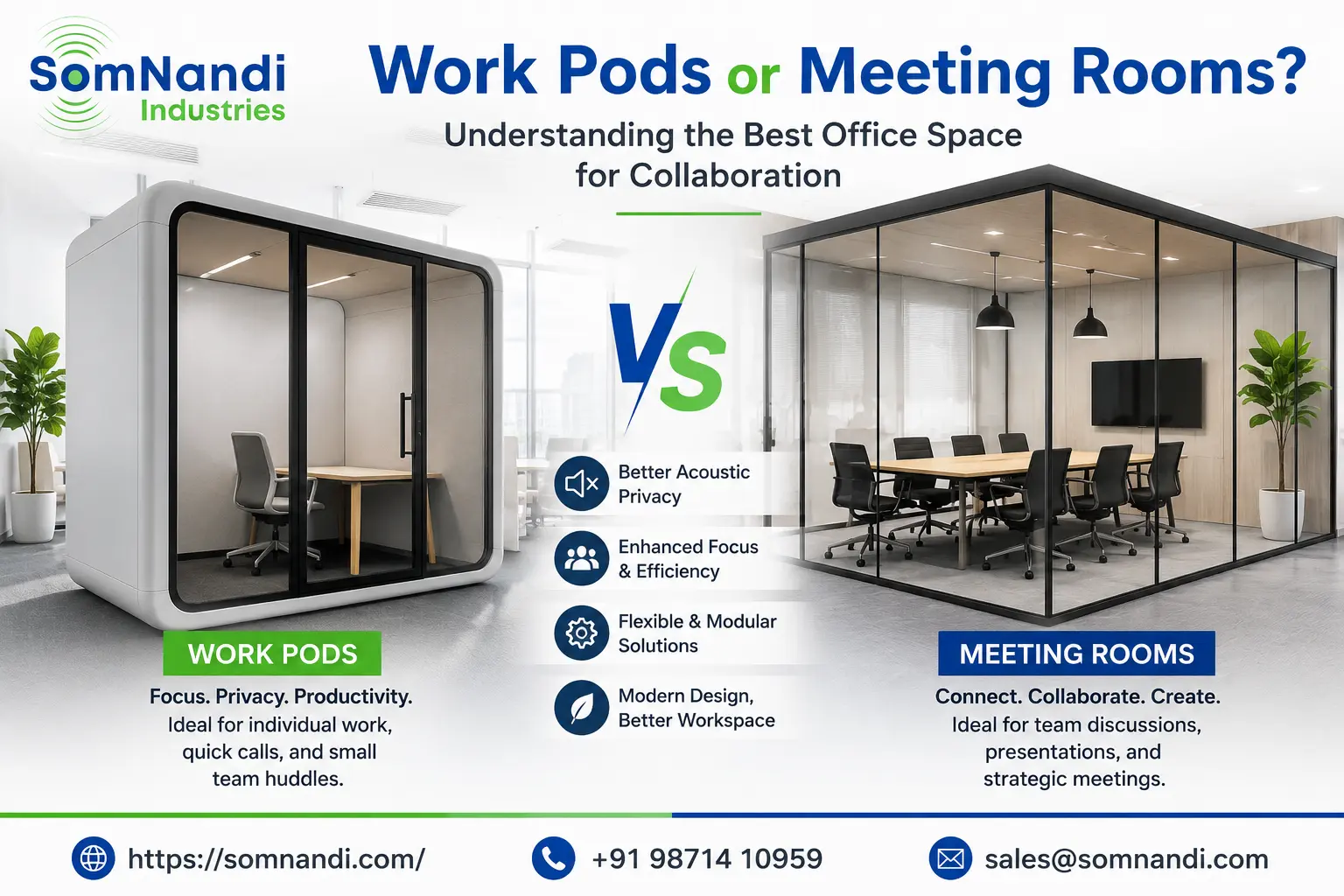
A work pod is a compact, self-contained, soundproof structure installed directly inside an open office. Unlike a fixed conference space, a work pod requires no permanent walls or major construction. It is engineered with acoustic materials that absorb sound, reduce echo, and block outside noise, creating a private zone for focused work, confidential calls, or quick discussions.
Work pods, sometimes called working pods or acoustic booth offices, are available in multiple sizes, from single-seat units to larger group configurations. Where a fixed conference space stays formal and permanent, a work pod is modular, quick to install, and easy to reposition as office needs evolve. This makes it a practical choice for companies that want the same privacy benefits without the cost and permanence of construction.
What Is a Meeting Pod and When Should You Choose It Over Meeting Rooms?
A meeting pod sits between a solo work pod and a full-size conference room. It is built for small group collaboration, typically three to six people, and is ideal for stand-ups, sprint reviews, brainstorming sessions, and client video calls that do not require a full conference booking. Many offices find that a meeting pod gets booked more often than their formal meeting rooms simply because it is easier to access and better matched to everyday team sizes.
Choose a meeting pod over meeting rooms when your team needs a short, unscheduled huddle, when your existing setup is constantly overbooked, or when you want to add collaborative capacity without renovating. Choose the larger, formal option when you need to host bigger groups, client presentations, or discussions that call for a full table and more equipment.
How Do Work Pods and Meeting Pods Compare to Traditional Meeting Rooms on Cost and Flexibility?
| Factor | Meeting Rooms | Work Pod / Meeting Pod |
|---|---|---|
| Installation | Requires construction | Quick, modular setup |
| Flexibility | Fixed location | Can be relocated |
| Capacity | Large groups | 1 to 6 people typically |
| Best for | Formal meetings, presentations | Focused work, quick huddles, small team sessions |
| Acoustic control | Depends on build quality | Engineered acoustic materials |
A dedicated conference space remains essential for larger, formal collaboration, but a work pod or meeting pod fills the everyday gaps that it cannot always solve efficiently. Many offices now use both, reserving the larger space for scheduled, high-stakes discussions while relying on pods for spontaneous focus and small-group work.
Which Option Improves Employee Focus and Wellbeing More Effectively?
Workplace research consistently points to noise as one of the biggest drags on productivity. Gensler's Global Workplace Survey has found that acoustic comfort and access to private space are among the strongest predictors of whether employees feel they can do their best work in the office, and that noise and lack of privacy remain persistent complaints even in newly designed offices.
This is where a soundproof work pod adds real value alongside traditional formal spaces. Employees do not always need to book a room just to take a confidential call or concentrate on deep work. A nearby pod gives them that option instantly, reducing interruptions, lowering stress, and improving overall satisfaction with the workplace. When the larger spaces are reserved for group work and pods handle individual or small-team needs, offices tend to see better space utilization across the board.
How Is SomNandi Industries Helping Offices Rethink Meeting Rooms and Work Pods?
SomNandi Industries designs and manufactures soundproof work pods and acoustic booth offices built to complement, not just replace, traditional meeting rooms. Every pod uses high-quality, sound-absorbing panels, insulated glass, ergonomic interiors, and proper ventilation to create a comfortable and professional environment.
SomNandi Industries offers work pods in 2-seater, 4-seater, and 6-seater configurations, allowing businesses to choose the right size for focused work, confidential calls, or small meetings that do not require a full conference setup. Because these pods are modular, they can be installed quickly and relocated as office layouts change, something a fixed enclosed space cannot offer. Corporate offices, IT companies, co-working spaces, educational institutions, healthcare facilities, and legal practices all use SomNandi work pods to extend the value of their existing office layout while giving employees more accessible private space.
Conclusion
Meeting rooms and pod-based solutions are not competitors, they are complementary parts of a well-planned office. The larger, formal setup remains the right choice for scheduled, high-stakes collaboration, while a work pod or meeting pod fills the everyday need for quick, private, and acoustically controlled space. Businesses that combine both get the best of both worlds: full-scale capacity and the flexibility of pods. If your office is struggling with overbooked space or persistent noise complaints, SomNandi Industries can help you design and install the right mix of work pods and acoustic booth offices for your team.
Frequently Asked Questions
Not entirely. Meeting pods handle small, quick sessions well, but a larger, formal conference space is still better for group presentations.
Work pods usually range from 1 to 6 seats, with 2-seater, 4-seater, and 6-seater options covering most office needs.
Yes, quality work pods use acoustic panels and sealed construction to significantly reduce noise transfer in both directions.
Generally yes, since pods avoid construction costs and can be installed and relocated without major renovation work.
Most work pods are modular and designed for disassembly and relocation, unlike permanent meeting rooms.
SomNandi Industries designs and manufactures premium work pods, meeting pods, and acoustic booth offices for modern workplaces. Contact SomNandi Industries to plan the right mix of meeting rooms and pods for your office.