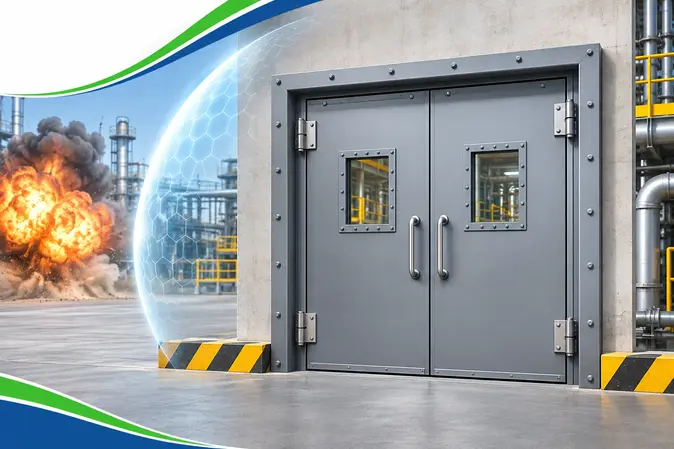
An explosion can destroy more than the equipment it starts in. The pressure wave travels through openings and puts people and operations at risk. Blast Resistant Doors are engineered steel assemblies that keep an opening sealed and structurally intact under that load.
What Are Blast Resistant Doors?
A blast resistant door resists a pressure wave and debris impact. It is also called a blast proof door or anti blast door. The leaf, frame, hinges and seals work as one system, so the rating depends on all of them.
What Types of Steel Blast Doors Are Available?
Single leaf and double leaf doors
Single leaf doors suit standard openings. Double leaf doors suit wider equipment room openings.
Hinged and sliding doors
Hinged doors suit most openings with swing space. Sliding doors help where clearance is limited or equipment must pass through.
What Are the Benefits of Blast Proof Doors?
Blast and fire protection
SomNandi doors are rated up to 40 bar peak reflected overpressure, with fire resistance up to 180 minutes (BS 476 Part 20 and 22).
Does a blast door reduce noise and echo?
Not by design. Its job is pressure resistance, and SomNandi publishes no acoustic or NRC rating for these doors. If you need echo control, specify acoustic doors or wall treatment separately.
Handling and installation
Doors are custom sized, and operation can be manual, hydraulic, pneumatic or electric. Installation follows a clear sequence: hazard assessment, frame anchorage review, fabrication, sealing, on-site mounting, commissioning and handover documents.
Where Are Blast Resistant Doors Used?
Use depends on your hazard assessment. Typical settings include:
- Manufacturing and power plants: compressor rooms, transformer enclosures and boiler houses.
- Oil and gas facilities: control rooms, switchgear buildings and refuge areas.
- Water and wastewater plants: chemical storage and plant buildings.
- Data centres and commercial buildings: critical equipment rooms and secure zones.
- Hospitals: emergency and critical care areas. See our guide to Blast Resistant Doors for Hospitals.
- Airports, metro and railway facilities: control and utility spaces.
- Hotels, resorts and shopping malls: plant rooms and high-occupancy buildings.
- Residential developments and educational campuses: shared utility and safety areas.
What Affects the Price?
Cost depends on:
- Dimensions: larger openings need more steel and engineering.
- Thickness and pressure rating: higher ratings need heavier construction.
- Design: single or double leaf, hinged or sliding, and operation type.
- Quantity: order volume changes unit cost.
- Installation: site conditions and wall interface work.
Blast Resistant Doors Specifications
| Parameter | Specification |
|---|---|
| Peak reflected overpressure | Up to 40 bar |
| Fire resistance | Up to 180 minutes, BS 476 Part 20 and 22 |
| Configuration | Single leaf and double leaf |
| Maximum size | 4 m wide by 6 m high, custom sizes available |
| Operation | Manual, hydraulic, pneumatic or electric |
| Sealing | Single or multiple gasket systems |
| Special options | EMP protection and radiation shielding on request |
Why Choose SomNandi Among Blast Resistant Doors Manufacturers?
SomNandi Industries is an ISO certified manufacturer with 150+ projects delivered. Our work includes a blast resistant door installation at the IOCL Refinery in Panipat and a fire-rated double leaf blast door supplied to L&T. Each door is engineered to the client’s site hazard assessment.
Frequently Asked Questions:
What is the purpose of a blast resistant door?
It protects critical openings from explosion pressure, debris and fire.
How much do blast resistant doors cost?
Price depends on pressure rating, size, configuration and operation type. Request a quote for your project.
Are blast resistant doors soundproof?
They are not sold as soundproof doors, and no acoustic rating is published. SomNandi makes separate acoustic doors for noise control.
Where are blast resistant doors used?
They are used in oil and gas, petrochemical, defence, nuclear and other critical infrastructure. Other buildings use them when a risk assessment calls for it.
Are blast resistant doors made from recycled materials?
SomNandi makes no recycled content claim for these doors, so ask the sales team for material details.