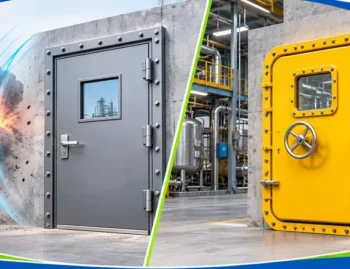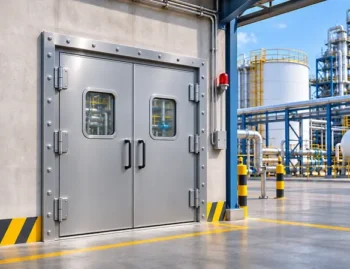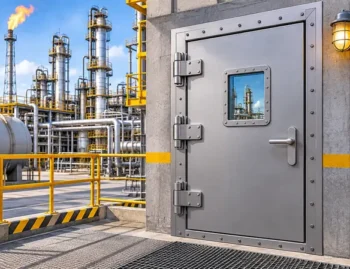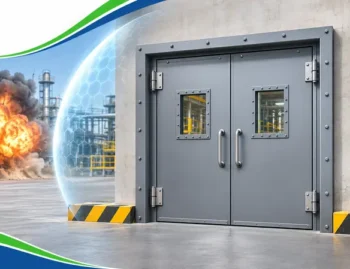
Many project teams treat a heavy steel door as a safe answer to every risk. It is not. The choice between a blast resistant door and a fire door depends on the hazard behind the opening. This guide explains the Blast Resistant Door vs Fire Door question for refineries, power plants, hospitals, data centres, airports and other facilities.
What Is the Difference Between a Blast Resistant Door and a Fire Door?
What does a fire door do?
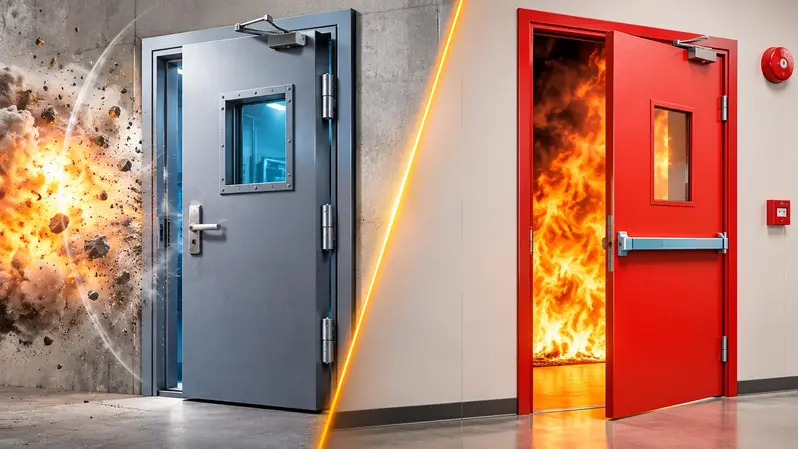
A fire door slows the spread of flame, heat and smoke for a rated period. It protects escape routes and separates fire compartments. This is the usual fire door difference: it manages fire, not explosion pressure.
What does a blast resistant door do?
A blast resistant door is a steel door assembly built to withstand an explosion's pressure wave and debris while the opening stays sealed. Its rating comes from your hazard assessment, not a fixed catalogue number. For a related comparison, read our guide on Blast Resistant vs Explosion Proof Doors .
Do You Need a Fire Rated Blast Door?
If the risk includes both explosion and fire, yes. A fire and blast door covers both threats in one assembly. SomNandi doors are available with fire resistance up to 180 minutes under BS 476 Part 20 and 22. Fire and blast ratings are tested separately, so a high fire rating does not mean a high blast rating.
An ATEX door question is different. ATEX relates to equipment in explosive atmospheres. We do not claim ATEX certification here, so confirm your requirement with our engineers.
Where Are These Doors Used?
Use a blast resistant door where a hazard assessment calls for one. A fire door usually serves everywhere else.
- Gas refineries, oil and gas facilities, power plants: control rooms, switchgear buildings and compressor rooms.
- Manufacturing and water or wastewater plants: chemical stores and process areas.
- Data centres, hospitals, airports, metro and railway facilities: critical or high-risk openings.
- Commercial buildings, malls, hotels and resorts, residential developments, educational campuses: fire doors for compartments, with blast doors only where a specific threat is identified.
What Affects the Price?
These factors drive the quote:
- Dimensions: Larger openings need heavier leaves and frames.
- Thickness: Set by the required pressure and fire rating.
- Design: Single or double leaf, hinged or sliding, and the type of operation.
- Quantity: Repeat orders affect fabrication planning.
- Installation: Wall interface, anchorage and commissioning scope.
What Do the Verified Specifications Say?
| Parameter | Specification |
|---|---|
| Peak reflected overpressure | Up to 40 bar |
| Fire resistance | Up to 180 minutes, BS 476 Part 20 and 22 |
| Configuration | Single leaf and double leaf |
| Maximum size | 4 m wide by 6 m high, custom sizes available |
| Operation | Manual, hydraulic, pneumatic or electric |
| Sealing | Single or multiple gasket systems |
| Special options | EMP protection and radiation shielding on request |
Why Choose SomNandi Industries?
SomNandi Industries is an ISO certified manufacturer with 150+ projects delivered, according to our product page. Documented work includes an installation at the IOCL Refinery, Panipat, and a fire rated double leaf blast door supplied to L&T.
The team designs and builds steel blast doors, blast proof doors and anti blast door assemblies around your site's hazard data. Among blast resistant doors manufacturers, we also supply blast resistant enclosures and bullet resistant doors.
Frequently Asked Questions
What is the purpose of a blast resistant door?
It protects critical openings from explosion pressure, debris and fire.
How much does a blast resistant door cost?
Price depends on pressure rating, size, configuration and operation type. Send us your requirements for a quote.
Are blast resistant doors soundproof?
They are not sold as acoustic products, and no NRC figure is published. For noise control, our acoustic doors are the better fit.
Which applications need them?
Oil and gas, petrochemical, defence and nuclear sites mainly use them. Other facilities need them only where a hazard assessment requires it.
Are they made from recycled materials?
We have no verified recycled content or environmental claim to share. Ask our team for current material details.