Every circuit board gives off a small amount of energy into the air around it. Most of the time, this does not cause any problem. But if you put two devices close to each other, this energy can start causing real trouble. A router that loses signal near a microwave. A sensor panel that glitches every time a nearby motor turns on. This is the exact problem an EMI chamber is built to catch — before the product ever reaches a customer. It gives engineers a clean, closed space to see exactly what a device is sending out, and how well it can handle outside interference, without any outside noise disturbing the readings.
So here is a simple, practical guide. What an EMI chamber is. How an EMI test chamber works. Which specs actually matter, and which ones are just marketing talk. Where the downsides are, because there are downsides. And why so many manufacturers across India now trust SomNandi Industries to build reliable EMI testing setups.
What Is an EMI Chamber?
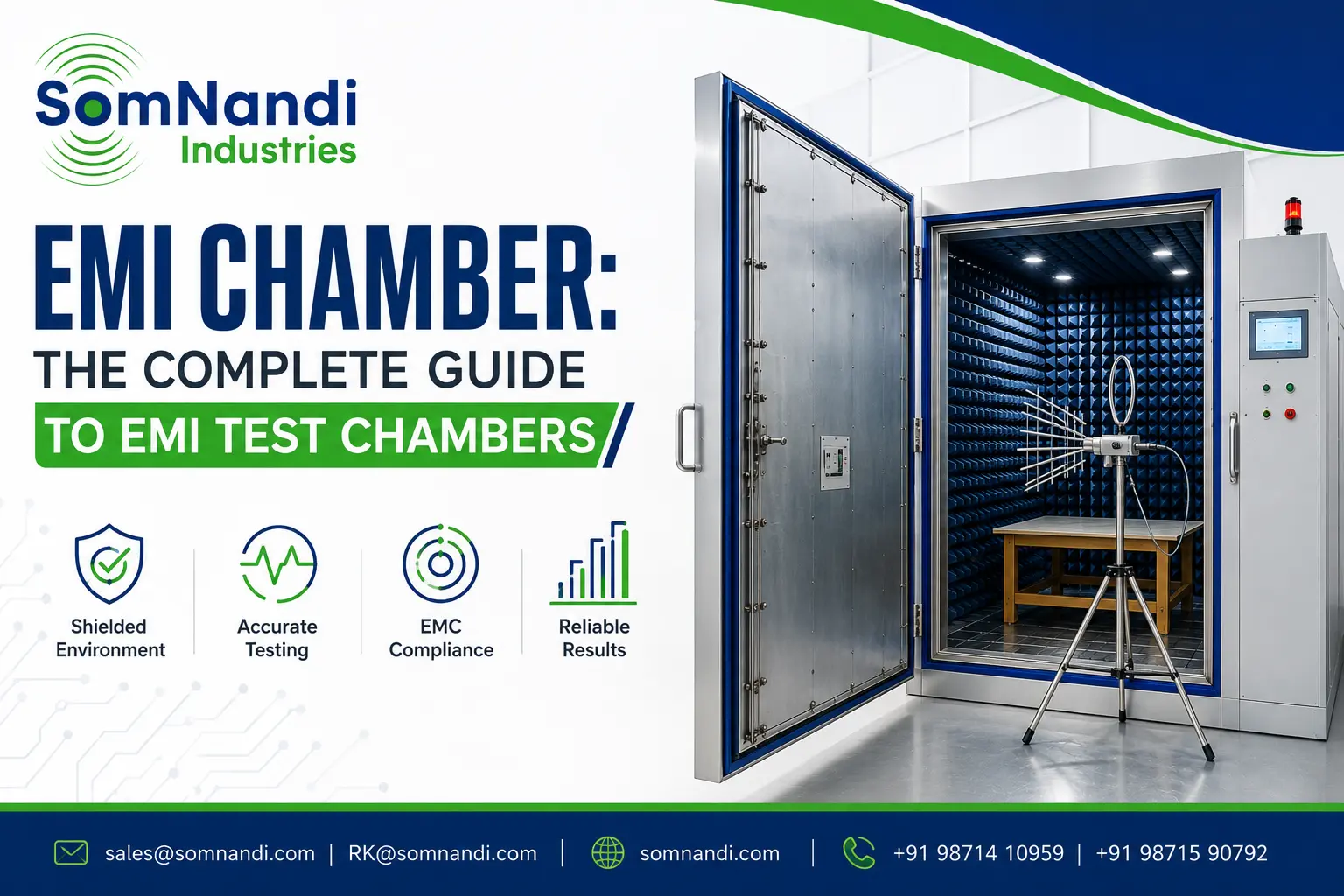
People call it different names — an EMI chamber, an anechoic chamber, or just "the shielded room." At its core, it does one or both of two jobs: it keeps outside electromagnetic signals from getting in, and it stops signals from inside the room from leaking out. A metal shell wraps around the whole room to do this. Special RF-absorbing material lines the inside walls on top of that. Together, these create a space where engineers can measure what a device sends out, and how sensitive it is to outside interference, without any stray signal messing up the numbers.
Why does this matter? Because of EMI testing. This is a formal process that checks whether a product truly meets electromagnetic compatibility (EMC) standards before it can be sold. Skip this step, or test in an open, unshielded space, and the readings get affected almost immediately. Wi-Fi routers, mobile towers, and anything else running nearby will all leak into the measurement in some way.
How Does an EMI Test Chamber Actually Work?
Two things make an EMI test chamber work: shielding and absorption. The outer shell is usually made of galvanized steel or copper mesh. It works like a Faraday cage, blocking outside electromagnetic waves right at the door. Inside, pyramid-shaped foam absorbers or ferrite tiles cover the walls, ceiling, and sometimes the floor. These soak up any signal that would otherwise bounce around and disturb the reading.
During a test, the product sits on a turntable or a fixed stand. Calibrated antennas pick up its emissions across a set frequency range. These readings are then checked against limits set by bodies like the FCC, CISPR, or India's own BIS. If the chamber is built correctly, the results come out clean, repeatable, and reliable enough to pass a certification audit without any issues.
EMI Chamber Specifications Worth Knowing
Not every chamber is built to the same standard — not even close. Frequency range is usually the first thing to check. Most industrial chambers cover somewhere between 9 kHz and 40 GHz, depending on whether the goal is low-frequency conducted emissions or higher-frequency radiated emissions. Shielding effectiveness matters just as much. It is measured in decibels, and anything between 90 and 120 dB is considered solid for a serious facility.
There is also something called site attenuation, or NSA for short. This is a check that confirms the chamber behaves the way an open-field test site would, and most certification standards require it. Absorber choice matters too — pyramidal foam versus hybrid absorbers versus ferrite tiles — and the right choice mostly depends on the lowest frequency the chamber needs to handle.
Size is its own topic. It could be a small benchtop unit for testing one component, or a walk-in room big enough for full machinery. It all depends on what is being tested. Ventilation and power filtering also matter a lot — EMI-filtered power lines and honeycomb air vents keep the space breathable without creating a gap in the shielding. And generally, the lower the background noise in the chamber, the more accurate and trustworthy the measurements will be.
None of these numbers mean much on their own. They only make sense when matched to whatever is actually being tested, whether that is automotive electronics, telecom equipment, defence hardware, or industrial control panels.
Why Bother with an EMI Chamber?
Fair question, especially given how much it costs to build one. Regulatory pressure is probably the biggest reason. Almost every country requires EMC certification before an electronic product can be sold legally, and owning an EMI test chamber means not having to wait for a slot at someone else's lab. There is a cost angle too. Once a chamber is built, there are no repeated booking fees at an outside lab every time a design change even slightly.
Development also speeds up, since engineers can retest right after making a change instead of shipping the unit out and waiting weeks for a slot elsewhere. Confidentiality matters here too — products that have not launched yet never need to leave the building, which is important when there is an unreleased design involved. Results also stay more consistent, compared to moving between different labs with changing conditions each time.
Benefits of Having an EMI Chamber on Site
The benefits go well beyond just meeting a compliance requirement. Product reliability tends to improve, since devices that go through thorough EMI/EMC testing are less likely to malfunction once they are out in the field near other equipment. Time-to-market also shrinks, mostly because there is no more waiting for an external lab slot to open up.
The design feedback loop gets tighter too. Engineers catch interference problems while a fix is still cheap and simple, instead of after production has already started and the mistake is baked into thousands of units. Passing tough EMI tests also builds real trust with B2B buyers and regulators. A well-built chamber also gives flexibility across standards, usually able to handle FCC, CE, BIS, or MIL-STD testing without needing a separate facility for each one. And there is room to grow later, since chambers can be upgraded as a product range expands or frequency needs change.
Where an EMI Chamber Falls Short
This would not be much of a guide if it only covered the good parts. The trade-offs are real, so here they are. Upfront cost is the obvious one. Construction, absorber material, shielding, and calibration equipment are all expensive, even before the chamber is up and running. Larger chambers also take up a lot of floor space, especially ones built for full-size equipment instead of small components.
Maintenance never really stops either. Absorbers wear down over time. Gaskets wear out. Recalibration has to happen on a fixed schedule, whether that is convenient or not. Running the chamber well also needs people who genuinely know what they are doing — operating an EMI test chamber and reading the results correctly takes trained RF and EMC engineers, not just anyone who happens to be free. Energy costs go up too, especially in larger chambers that need steady climate control to keep their numbers stable.
Even with all this, most manufacturers doing continuous product development still say it is worth it in the end. Faster compliance and less dependence on outside labs tend to pay back that cost over time.
Where EMI Testing Actually Gets Used
EMI testing inside a properly built EMI chamber shows up in more industries than most people expect. Automotive electronics go through it constantly — ECUs, infotainment systems, and sensor modules are all checked for interference immunity before they ship. Telecom equipment gets the same treatment, making sure routers, base stations, and networking hardware do not interfere with each other's signals once deployed together in the field.
Defense and aerospace face an even tougher version of this, held to standards like MIL-STD-461, where the cost of a failure is far worse than a dropped Wi-Fi connection. Industrial automation depends on it heavily too, since PLCs, drives, and control panels all need to survive electrically noisy factory floors without glitching mid-shift. Consumer electronics get cleared through EMI testing before launch as a routine step at this point, and medical devices go through arguably the strictest version of all, because interference there is not just annoying — it can actually put someone at risk.
Why SomNandi Industries Is Worth Talking To
For manufacturers building, upgrading, or sourcing EMI chamber infrastructure, SomNandi Industries brings real engineering depth in acoustic and electromagnetic shielding. They have built a strong name in industrial enclosures by designing shielded environments around exactly this kind of spec sheet: shielding effectiveness, absorber selection, and chamber sizing that actually fits the product line instead of a generic template pulled off a shelf.
What stands out about SomNandi Industries is the mix of precision engineering with practical, India-based support. Need a compact benchtop EMI chamber for component-level testing? Or something bigger, built for full industrial equipment? Either way, the team works directly with clients to find a chamber that balances performance, budget, and long-term maintenance. Their background across blast-resistant enclosures, acoustic baffles, and power test chambers carries straight over into this space too — the same engineering discipline, just applied to EMI shielding.
Working with SomNandi Industries means more than just buying a chamber off a spec sheet. It is a team that understands both the technical side and the day-to-day reality of running an EMI testing facility, which makes the whole path from concept to certified product much smoother than trying to figure it out alone.