Anechoic and EMC Chambers
Anechoic and EMC Chambers are purpose-built test rooms that remove reflections, so engineers measure only what a product truly emits or receives. Whether the goal is quieter machinery or compliant electronics, these rooms turn an unpredictable environment into a repeatable laboratory. This guide explains how they work, how they differ, and how to choose one with confidence.
What Is an Anechoic Chamber?
An anechoic chamber, meaning “without echo,” is a controlled room that absorbs sound or electromagnetic waves instead of bouncing them back. The interior behaves like an open field, so only the direct signal reaches the sensor. An acoustic anechoic chamber handles sound, while RF versions handle radio energy. Both are shielded from outside interference, which is why they appear in aerospace, automotive, electronics and research labs.
Acoustic Testing
Controls sound reflections for accurate acoustic measurements and product noise testing.
RF Testing
Reduces electromagnetic reflections and outside interference during electronics testing.
How Do Anechoic and EMC Chambers Work?
Two things happen at once.
01. Isolation
Heavy, vibration-decoupled walls and floors help keep external noise or signals out, creating a controlled testing environment.
02. Absorption
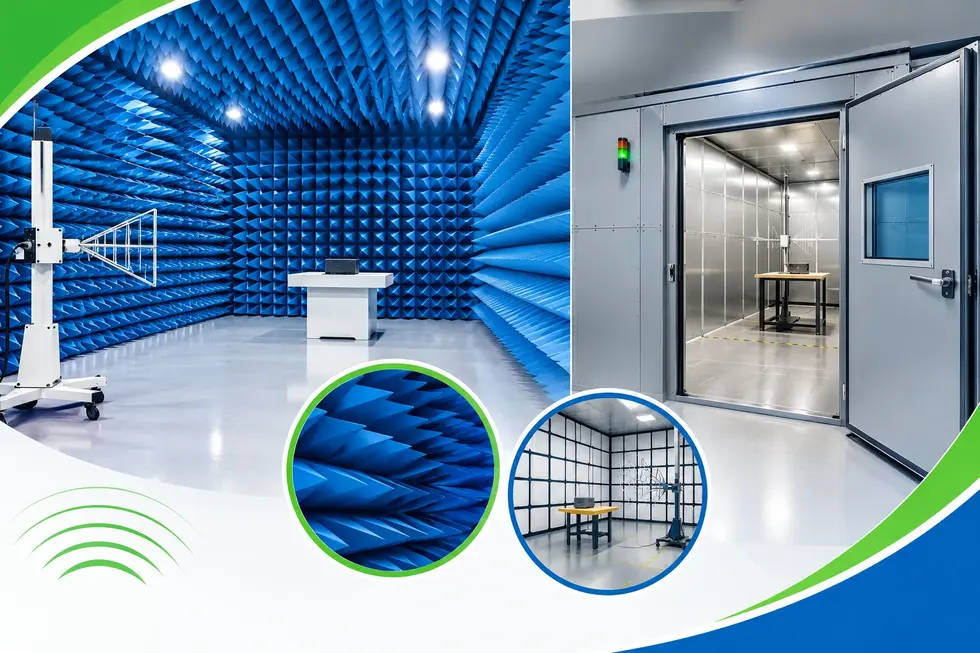
Interior lining converts incoming energy into heat. For sound, fiberglass or foam wedges are used. For radio waves, ferrite is a common material applied to the walls of EMC anechoic chambers.
SomNandi Industries
Explore the role of anechoic wedges and EMC test chambers in accurate acoustic and electromagnetic testing.
Why Is an Anechoic Wedge So Important?
An anechoic wedge is a tapered absorber. Its shape creates a gradual transition from air to material, so waves enter the wedge rather than reflect off it. Wedge depth is matched to the lowest frequency of interest, so low frequency machinery testing needs deeper wedges. This geometry defines true anechoic chamber sound quality.
What Is an EMC Test Chamber?
An EMC test chamber is a shielded room lined with radio absorbers, used to check how much energy a product radiates and how it reacts to external fields. The device sits on a turntable, and the absorbing material minimizes reflections so measured emissions come mainly from the device itself. The semi anechoic chamber is the most common EMC facility, although fully anechoic rooms with absorber on all six surfaces give the best suppression of multipath reflections.
Is a Soundproof Chamber the Same as an Acoustic Anechoic Chamber?
No. A soundproof chamber blocks outside noise but leaves internal reflections, so readings carry reverberation error. A sound absorbing chamber removes those reflections as well. When your test demands free field accuracy, an acoustic chamber with true wall and ceiling absorption is essential. An audio anechoic chamber for microphones, speakers and headphones follows the same principle.
What Goes Into Acoustic Anechoic Chamber Design?
Good acoustic anechoic chamber design starts with the test standard, the lowest frequency, and the size and weight of the product.
Full Chambers
Use a suspended mesh floor over a wedge lined cavity.
Semi Anechoic Chambers
Use a solid floor for engines, appliances and vehicles.
Mini Chambers
Suit small devices and components.
Strong acoustic chamber design also covers ventilation silencers, acoustic doors, viewing panels and final free field verification.
What Affects Anechoic Chamber Price and Cost?
Anechoic chamber price cannot be quoted honestly without a brief. Anechoic chamber cost depends on chamber type, size, target frequency range, absorber material, vibration isolation, shielding, doors, ventilation, site condition and validation scope.
Share your test requirement and ask for a scoped proposal rather than relying on a generic number. Compare proposals on standards compliance and verification, not on size alone.
Where Can I Find Anechoic Chambers Near Me?
Start with university acoustics and electronics departments, national metrology laboratories, accredited EMC test houses and automotive R&D centers, since many rent test time.
If you need a dedicated facility, a turnkey manufacturer such as SomNandi Industries designs, installs and validates chambers for Indian industry.
Conclusion
Anechoic and EMC Chambers solve one core problem: measurement you can trust. Acoustic versions use wedges and isolation to create a free field for sound, while EMC versions use shielding and radio absorbers to create a clean electromagnetic space.
Define your test standard, frequency range and product load first, then choose full, semi or mini formats. A clear brief leads to a better design, a fair quote and defensible results.
SomNandi Industries can support that process from concept to commissioning.
Frequently Asked Questions
Anechoic Chambers: Everything You Need to Know
1 Is an anechoic chamber really the quietest place on Earth?
Some are among the quietest man-made spaces, with background levels below the threshold of human hearing. Performance depends on design, isolation and the frequency range.
2 Why can you hear your own heartbeat inside one?
With external noise and reflections removed, internal body sounds become noticeable. That is why long stays can feel disorienting.
3 What is the difference between an anechoic and a reverberation chamber?
An anechoic chamber absorbs reflections to create a free field. A reverberation chamber does the opposite and creates a diffuse field for different test methods.
4 What is a semi-anechoic chamber?
It has absorbers on the walls and ceiling but a reflective, solid floor. This supports heavy products and mimics open-area testing.
5 Can I build a DIY anechoic chamber at home?
You can reduce echo with absorbers, but you cannot reach certified free-field performance without engineered isolation and validation. Home setups suit casual audio checks only.