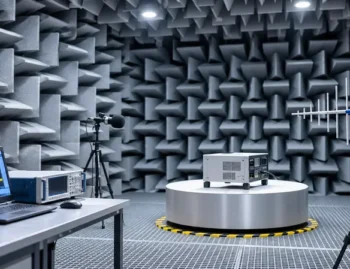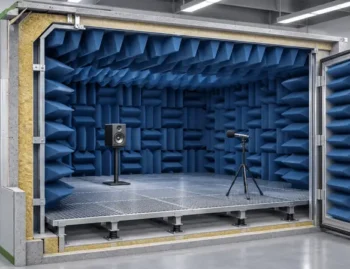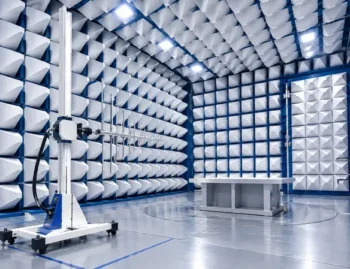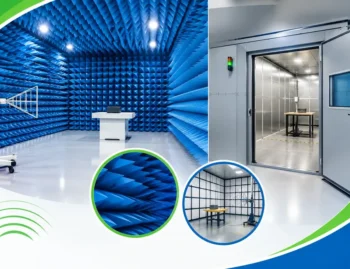
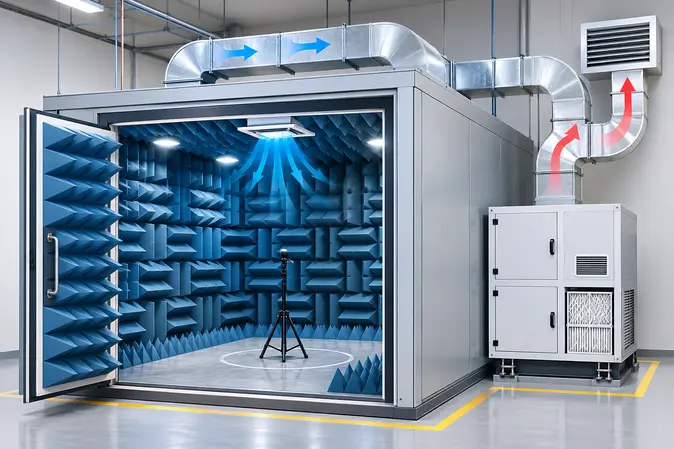
Test equipment produces heat. Amplifiers, drives, turntables and the device under test all add load to a sealed room. Anechoic chamber ventilation removes that heat while protecting the quiet, reflection-free conditions the room exists to provide.
What Is Anechoic Chamber Ventilation?
Anechoic Chamber ventilation is the supply, extraction and conditioning of air in a chamber. It keeps temperature and humidity stable for people and instruments. It must do this without adding noise, leaking sound or creating reflective surfaces.
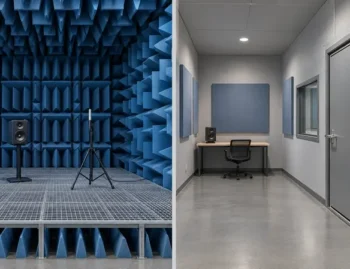
Absorption controls reflections inside the room. Sound isolation, which stops outside noise entering, needs a properly designed building assembly. Ventilation openings are weak points in that assembly, so they need acoustic treatment.
Why does equipment heat matter in a test room?
Heat shifts instrument readings and tires operators. Airflow that is too fast also creates its own noise, which can contaminate measurements. Good design balances cooling capacity against air velocity.
How does an anechoic chamber absorb sound?
Wedges or panels made of porous material line the surfaces. Sound enters the material, and friction in the fibres turns that energy into small amounts of heat. The wedge shape lets sound in gradually rather than bouncing off a flat face. Our guide to Anechoic Chamber Testing explains how this supports accurate measurement.
What Are the Benefits of Well-Designed Ventilation?
- Echo reduction: Attenuated openings avoid hard, reflective grilles that disturb the absorber layout.
- Handling and installation: Modular attenuators and duct sections are planned with the chamber, which reduces site rework.
- Heating: Controlled supply air holds a steady working temperature during long tests.
- Ventilation: Steady fresh air supports occupant comfort and clears heat from powered equipment.
Where Is It Applied?
- Manufacturing plants: machine and component noise testing.
- Power plants: generator accessory and turbine auxiliary checks.
- Commercial buildings: HVAC and fit-out product validation.
- Data centres: server and cooling fan studies.
- Hospitals: medical device noise assessment.
- Hotels and resorts: quiet plant selection for guest areas.
- Shopping malls: escalator and lift equipment review.
- Residential developments: appliance and plant room evaluation.
- Airports: ground equipment and announcement system tests.
- Metro and railway facilities: signalling and ventilation unit testing.
- Oil and gas facilities: compressor and enclosure measurement.
- Water and wastewater plants: pump and blower noise checks.
- Educational campuses: teaching labs and acoustic research.
Architects can use these requirements early to reserve plant space and duct routes.
What Affects Anechoic Chamber Price?
Any anechoic chamber price depends on project scope. Key factors are:
- Dimensions: larger rooms need more absorber, structure and airflow capacity.
- Thickness: deeper absorbers suit lower frequencies and take more space.
- Design: full, semi or EMC chamber layouts change the scope.
- Quantity: larger volumes can change unit cost.
- Installation: site access, finishes and timelines.
Specifications Table
The product data below must be confirmed before publishing. We found no verified figures on the source pages, so none are stated.
| Parameter | Value |
|---|---|
| Absorber type | Confirm with Somnandi |
| NRC | Insert value from a test report |
| Fire classification | Insert certified class |
| Recycled content | Insert verified percentage |
| Lower cut-off frequency | Confirm per design |
| Ventilation airflow | Confirm per heat load |
Why Somnandi Industries?
Somnandi Industries, based in Greater Noida, lists anechoic chambers, reverberation chambers, NVH test chambers, sound attenuators, acoustic louvers and industrial silencers among its products. This range supports chamber and ventilation planning from one source. Add project names, certificates and lab reports before publishing any performance claim.
Frequently Asked Questions:
What is the purpose of anechoic chamber ventilation?
It removes heat and supplies fresh air while keeping noise and reflections low.
What is the price?
It depends on size, thickness, design, quantity and installation. Please request a quotation.
Does an anechoic chamber work as a soundproof chamber?
Not alone. Absorbers control internal echoes. Isolation needs a suitable building assembly.
Where is it used?
It serves industry, infrastructure, healthcare, hospitality, retail, housing and education. Search “anechoic chamber near me” to compare suppliers, then check their project evidence.
Can recycled materials be used?
Some absorbers include recycled content. Ask for documented percentages before relying on any claim.
Request a Quotation
Planning a chamber or an EMC chamber? Visit somnandi.com, email sales@somnandi.com or call +91 98714 10959.