Noise control starts with measurement. Even a simple product such as acoustic louvers for a generator room must let air through while cutting noise, and that balance needs proof. Anechoic chamber testing gives engineers a reflection-free space to measure sound accurately. This guide explains the process, standards, benefits and uses.
What Is Anechoic Chamber Testing?
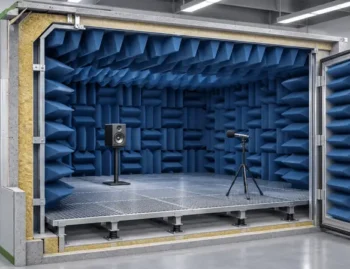
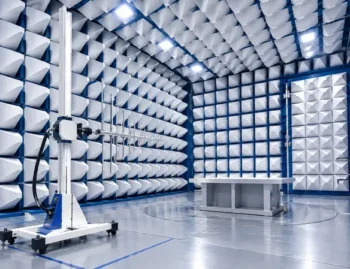
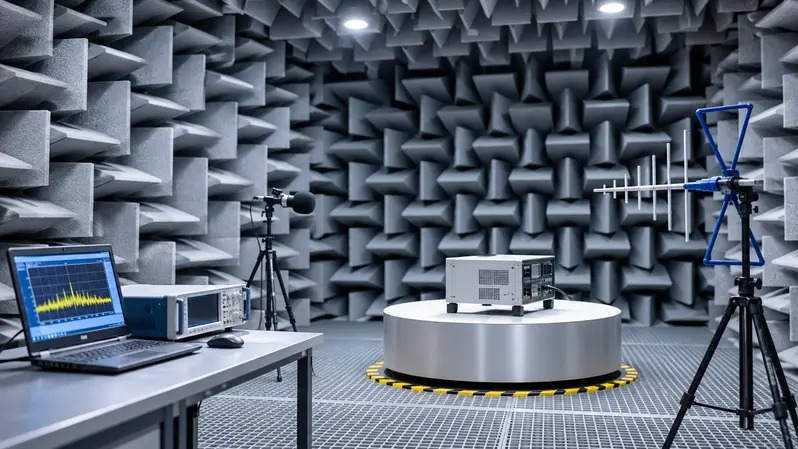
Anechoic Chamber is the measurement of sound or electromagnetic energy inside a room built to remove reflections. The room is lined with absorbing wedges or panels, so only the direct signal reaches the microphone or sensor. You may also hear it called an acoustic chamber, acoustic anechoic chamber, silent chamber or soundless chamber.
How Does an Anechoic Chamber Absorb Sound?
Why do reflections matter?
Hard surfaces bounce sound back and distort readings. Porous wedges trap sound waves in their fibres and convert the energy into tiny amounts of heat. The wedge shape lets sound enter gradually instead of bouncing off a flat face.
Is absorption the same as soundproofing?
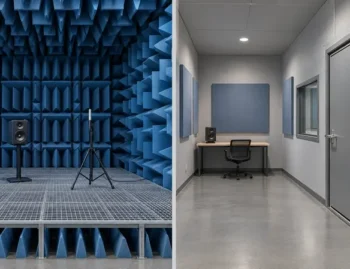
No. Absorption controls reflections inside a room. Sound isolation, which stops noise from entering or leaving, needs a properly designed building assembly with mass, sealing and decoupling. A good chamber needs both.
What Is the Testing Process?
How is a test carried out?
- Define the test goal, such as product noise, directivity or sensor response.
- Place the device under test on a stand at a set position.
- Position calibrated microphones at fixed distances.
- Run the signal and record the data.
- Compare results with the chosen standard and report.
What is a semi anechoic room?
A semi anechoic chamber has a reflective floor and absorbing walls and ceiling. It suits heavy equipment, vehicles and machinery that sit on the ground.
Which Standards Apply?
Projects usually reference ISO 3745 for sound power in anechoic rooms, along with relevant ISO and IEC test methods for the product. Always confirm the exact requirement with your consultant. Our guide to anechoic chamber specifications lists the design parameters to define before you build.
What Are the Benefits?
- Echo reduction: Absorbers keep reflections low, so measurements stay repeatable.
- Handling: Modular wedges and panels are lighter and easier to move than many alternatives.
- Installation: Planned modules shorten site work and reduce rework.
Where Is Anechoic Chamber Testing Used?
- Manufacturing plants: machine and component noise checks.
- Power plants: generator and turbine accessory testing.
- Commercial buildings: HVAC and fit-out product validation.
- Data centres: server and cooling fan noise studies.
- Hospitals: medical device noise assessment.
- Hotels and resorts: quiet equipment selection for guest areas.
- Shopping malls: escalator, lift and PA system evaluation.
- Residential developments: appliance and plant room noise review.
- Airports: ground equipment and announcement system checks.
- Metro and railway facilities: signalling and ventilation equipment tests.
- Oil and gas facilities: compressor and enclosure testing.
- Water and wastewater plants: pump and blower noise measurement.
- Educational campuses: teaching labs and audio research spaces.
Architects often use test data to specify materials with confidence.
What Affects Pricing?
Key factors include:
- Dimensions: larger rooms need more material and structure.
- Thickness: deeper absorbers handle lower frequencies.
- Design: full, hemi or semi anechoic layouts change the scope.
- Quantity: volume affects unit cost.
- Installation: site access, finishes and timelines.
Specifications Table
| Parameter | Value |
|---|---|
| Absorber type | Confirm with SomNandi |
| Absorber depth | Confirm per project |
| NRC | Insert value from a test report |
| Fire classification | Insert certified class |
| Recycled content | Insert verified percentage |
| Lower cut-off frequency | Confirm per design |
Fill each field only with data backed by a lab report or certificate.
Why SomNandi Industries?
SomNandi Industries works on acoustic solutions for industrial and commercial settings. Add verifiable proof here, such as completed project names, years in operation, test reports and certificates, so readers can check every claim.
Frequently Asked Questions:
What is the purpose of anechoic chamber testing?
It measures sound or signals without reflections, giving accurate and repeatable data.
How much does it cost?
Cost depends on size, thickness, design, quantity and installation. Request a quote for an exact figure.
Does an anechoic chamber soundproof a room?
Not by itself. Absorbers reduce internal echoes. Isolation needs a suitable building assembly.
Where is it applied?
It is used across industry, infrastructure, healthcare, hospitality, retail, housing and education.
Can recycled materials be used?
Some absorbers include recycled content. Ask for documented percentages before relying on any claim.
Request a Quotation
Ready to plan your chamber? Visit somnandi.com, email sales@somnandi.com or call +91 98714 10959.